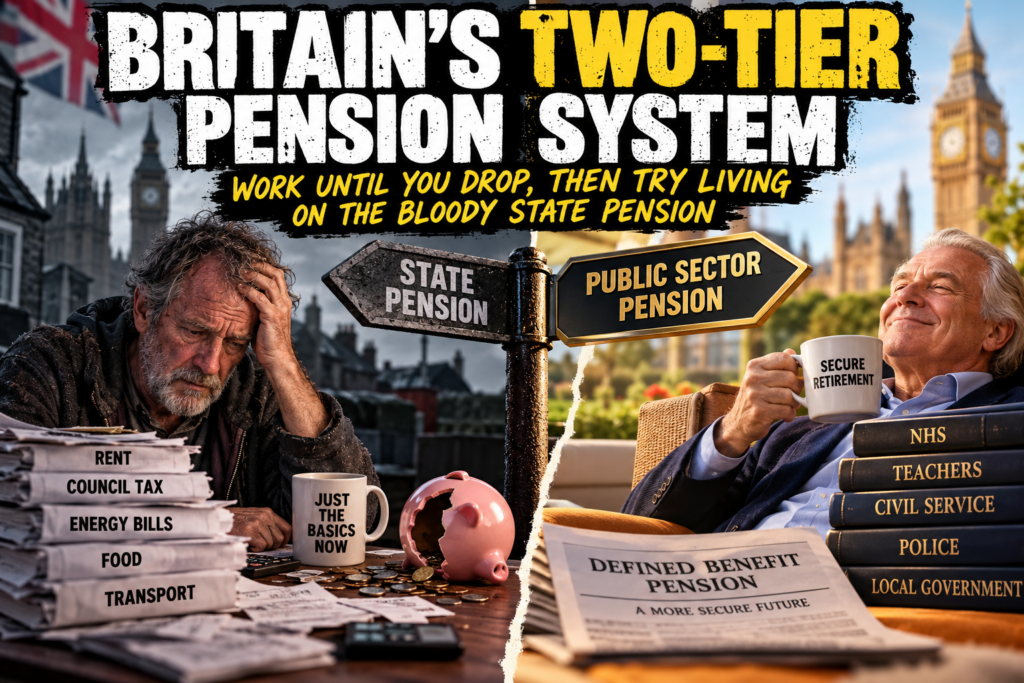
Why does a lifetime of work buy some people a secure retirement while millions of others are left counting pennies? And why are the lowest-paid workers expected to save money they haven’t bloody got?
There is something seriously wrong with the way Britain treats its pensioners.
Not all pensioners, mind you.
Some retire with a decent occupational pension, regular increases and a fairly good idea of what will land in their bank account each month.
Others retire after forty or fifty years of working, paying tax, raising families and contributing to society, only to discover that their reward is a State Pension that barely covers the basics.
And if they haven’t managed to build up a decent private pension?
Well, tough luck, apparently.
They should have saved more.
Saved more of what, exactly?
That’s the question nobody seems particularly keen to answer.
£138 billion sounds like a fortune. Until you divide it between millions.
The government spends an enormous amount on pensioner benefits.
Figures used in this comparison put annual expenditure at approximately £138 billion, including the State Pension and other benefits for older people.
There were around 13.2 million State Pension claimants in August 2025.
Divide £138 billion by 13.2 million and you get approximately £10,445 a year, or £201 a week.
Now, before somebody gets their calculator out and starts shouting, that isn’t the actual average State Pension. The £138 billion includes other pensioner benefits, and the figures don’t all cover precisely the same period.
The calculation simply illustrates how a seemingly enormous national budget looks when spread across millions of people.
The actual average State Pension payment in August 2025 was around £210.73 a week.
That’s about £10,958 a year.
Try living independently on that.
Pay your council tax, electricity, gas, water, insurance, food, telephone, clothing and all the other little expenses that never seem particularly little when the bills arrive.
And heaven forbid the washing machine packs up.
You can almost hear the government saying, “You should have planned for that.”
Of course. I’ll just pop down to the bottom of the garden and pick a few twenty-pound notes off the money tree.
Meanwhile, there’s another pension system

Now let’s look at public-sector occupational pensions.
The projected annual bill has been reported at around £58.2 billion for 2026–27, rising towards £60.2 billion in 2027–28.
Other estimates put annual pension payments across major public-service schemes at roughly £55 billion.
These are substantial sums.
The schemes cover people who worked in the Civil Service, NHS, education, policing, armed forces, local government and other public services.
Estimates suggest around 2.8 million to 3 million retired members receive pensions from the major schemes.
Using £55 billion and 3 million recipients gives a rough average of £18,333 a year.
That sounds rather different from the State Pension, doesn’t it?
But here’s an important distinction.
Public-sector occupational pensions are additional to the State Pension. They don’t replace it.
And the two spending figures aren’t directly comparable.
Public-service pensions have different funding arrangements. Some are supported by invested pension funds, while others operate largely through contributions and public expenditure.
The £55 billion also shouldn’t be confused with the net amount paid from general taxation.
So no, I’m not claiming every retired public employee gets £18,333 handed to them directly by the taxpayer.
What I am saying is that millions of public-sector workers have access to a type of retirement security that has become increasingly rare for everybody else.
And that deserves a bloody good discussion.
Don’t blame the nurse. Blame the system.
Before anybody starts accusing me of attacking nurses, teachers, firefighters or council workers, let’s get something straight.
I don’t begrudge them their pensions.
They worked for them.
Those pensions were part of the employment deal, and many workers made substantial contributions throughout their careers.
A nurse who spent forty years looking after sick people deserves a decent retirement.
So does a firefighter.
So does a teacher.
But here’s the bit that gets forgotten.
So does the warehouse worker.
So does the cleaner, delivery driver, shop assistant, factory worker, care worker and the bloke who spent forty years repairing machines.
The country doesn’t function without those people either.
Why should the person who spent their working life loading lorries have less retirement security than somebody employed by the state?
Different jobs carry different responsibilities and pay. Fair enough.
But why should one group have a pension income calculated under a defined-benefit scheme while another is left hoping their investments performed well?
The answer seems to be that we’ve allowed one system to survive while gradually dismantling the other.
The great private pension disappearing act
There was a time when large private employers commonly offered final-salary pensions.
You worked for the company, contributed to the scheme and built up an entitlement to a retirement income.
It wasn’t perfect, but at least you had some idea what you were working towards.
Then things changed.
Employers began closing defined-benefit schemes, often replacing them with defined-contribution pensions.
And that’s a very different animal.
Instead of being promised a particular retirement income, you and your employer pay money into an investment pot.
What you eventually receive depends on how much goes in, investment returns, charges and what happens when you retire.
Live longer than expected?
You’d better hope your money lasts.
Markets have a bad decade?
That’s your problem too.
The employer has largely transferred the investment risk onto the worker.
Meanwhile, many public-sector workers continue to benefit from defined-benefit arrangements, although most have moved away from traditional final-salary calculations towards career-average schemes.
These schemes still provide a pension calculated under established rules, generally payable for life.
One worker gets a retirement income promise. The other gets an investment account and a prayer.
And we’re supposed to regard that as perfectly normal.
You can’t save for retirement with money you haven’t bloody got
Now we come to the part that really gets up my nose.
The lowest-paid workers are constantly told they must take responsibility for their retirement.
Save more.
Invest more.
Put more into your pension.
Lovely advice.
But what happens when you’re working full-time for the minimum wage or only a little above it?
Let’s imagine you’re a cleaner, warehouse operative, supermarket worker or delivery driver.
You’ve paid the rent.
You’ve paid the council tax.
You’ve put money on the electricity meter.
You’ve filled the car or bought your bus ticket to get to work.
You’ve bought food.
And now you’re looking at what’s left until payday.
Perhaps you’ve got children.
Perhaps somebody in the household is ill.
Perhaps the car needs a new tyre.
Where the bloody hell is this extra pension money supposed to come from?
Under the standard workplace pension auto-enrolment rules, minimum contributions normally total 8% of qualifying earnings.
The employer contributes at least 3%, while the employee’s 5% share includes any applicable tax relief.
Let’s take somebody earning £25,000 a year.
Using the standard qualifying-earnings band, pension contributBritain’s Two-Tier Pension System: Why Ordinary Workers Lose Outions are calculated on £18,760.
That means approximately £1,500.80 a year goes into their pension at the minimum contribution rate.
Of that, the employer contributes around £562.80.
The remaining £938 comes from the employee contribution, including applicable tax relief.
For somebody earning £25,000, that’s not pocket change.
And after decades of paying in, there’s still no guaranteed pension income from that pot.
Now compare that with a public-sector defined-benefit scheme.
The public employee may pay a higher contribution rate, and the scheme has its own rules, but they are building up a pension entitlement calculated according to those rules.
The private-sector worker is building an investment pot.
Those are fundamentally different arrangements.
And for somebody struggling to pay today’s bills, the temptation to opt out of a pension is understandable.
Who can blame a parent for putting food on the table today rather than saving for retirement thirty years away?
But that decision can leave them even worse off when they eventually stop working.
We’ve built a system where the people who most desperately need a decent pension are often the least able to afford one.
That’s not financial responsibility.
That’s a bloody trap.
What about public-sector minimum-wage workers?
Now, I can already hear somebody objecting.
“There are low-paid public-sector workers too!”
Yes, there are.
And they deserve better pay just as much as low-paid workers anywhere else.
Public-sector workers are not exempt from the National Minimum Wage or National Living Wage, and it would be wrong to claim nobody in the public sector earns the minimum.
But minimum-wage jobs are much more concentrated in the private sector.
The Low Pay Commission has previously estimated that only a relatively small number of public-sector jobs were paid directly at the minimum-wage rate.
That doesn’t mean every public-sector worker is comfortably off. Far from it.
It does mean that a debate about pension fairness must consider the different employment and earnings structures across the two sectors.
And there’s something else.
When politicians compare public-sector and private-sector pay, they often focus on salaries.
But a secure, inflation-linked occupational pension can be worth a substantial amount.
If we’re comparing the rewards of working in different sectors, why pretend the pension doesn’t count?
Are public-sector workers paid less?
One familiar argument is that public-sector employees receive better pensions because their wages are lower.
Sometimes that’s true.
A highly skilled specialist might earn substantially more in private industry than in the NHS or Civil Service.
But the argument doesn’t hold across every occupation.
Broad comparisons have often shown higher median earnings in the public sector, while the private sector contains more extremely high earners who can push up average pay.
Hourly earnings comparisons can also favour public-sector workers.
However, those headline figures need care.
The two workforces are very different.
The public sector contains large numbers of qualified professionals, while the private sector includes a much greater proportion of low-paid retail, hospitality and other service workers.
Comparing the average worker in each sector without accounting for occupation, qualifications and hours can be misleading.
Still, the basic question remains.
Shouldn’t pension security be included when we discuss the overall fairness of employment rewards?
Because an extra pound in your wages today isn’t necessarily worth more than a dependable pension payment every month for the rest of your life.
And who’s paying for all this?
Another question worth asking is how public-service pensions are funded.
Not every public-sector pension scheme works in the same way.
The Local Government Pension Scheme, for example, holds substantial invested assets.
Other major public-service schemes are largely unfunded, with pension payments met through current contributions and public financing.
Some estimates suggest annual payments of around £55 billion against approximately £49.9 billion in employer and employee contributions across the schemes being compared.
That leaves a difference of roughly £5.1 billion.
But don’t mistake that for the entire taxpayer cost.
Public-sector employer contributions are themselves substantially financed from public budgets, and pension liabilities extend many years into the future.
At the same time, employees have made contributions and earned pension rights under their employment contracts.
It’s a complicated financial picture, not simply a case of the government handing out free money.
But complexity shouldn’t prevent scrutiny.
Taxpayers are entitled to understand the costs.
And they’re entitled to ask whether the retirement system is fair to the people financing it.
Particularly when many of those taxpayers are struggling to build pensions of their own.
The real problem is that we’ve normalised pension poverty
This is where I think the entire argument has gone wrong.
Every time somebody raises public-sector pensions, the discussion quickly becomes a demand to cut them.
Why?
Why should a retired nurse lose pension rights because a retired warehouse worker has inadequate provision?
Why should we make one person’s retirement worse rather than asking how to improve everybody else’s?
That’s the same tired old argument we’ve heard for years.
One group has something decent.
Another group doesn’t.
So instead of asking why the second group has been left behind, somebody demands that the first group lose what they’ve got.
That’s not fairness. That’s spreading the misery around.
The problem isn’t that public-sector pensions are too good simply because they provide security.
The problem is that too many other pensions provide too little.
We’ve allowed employers to shed long-term pension responsibilities.
We’ve told workers to take greater personal responsibility.
We’ve encouraged people to invest.
And we’ve largely ignored the uncomfortable reality that somebody earning barely enough to survive cannot magically create retirement wealth.
A pension system that works reasonably well for somebody earning £50,000 can look very different to somebody earning £23,000.
The bills don’t shrink just because your wages are smaller.
Perhaps we should ask the questions politicians avoid
If Britain is serious about pension fairness, we need to stop treating retirement as though it’s simply a matter of individual financial discipline.
We should be asking:
- Why isn’t the basic State Pension enough to guarantee a reasonable standard of living for everyone?
- Why have secure occupational pensions become so rare in much of the private sector?
- Why are minimum employer pension contributions so modest?
- Should low-paid workers receive greater pension support without having to sacrifice money they need for everyday living?
- Could collective pension arrangements give private-sector workers more dependable retirement incomes?
- And why do we discuss pension spending as a burden without giving equal attention to the value of a lifetime’s work?
There won’t be easy answers.
Improving pensions costs money.
Employers, employees and taxpayers would all have to contribute to a solution.
But surely a wealthy country can at least have an honest conversation about what retirement should look like.
Instead, we seem to have settled on telling people to save more while allowing millions to earn too little to do so.
Forty-five years of work, and you’re still counting pennies
Imagine two people.
Both leave school young.
Both work for forty-five years.
Both pay taxes and National Insurance.
Both help raise families.
Both contribute to keeping the country running.
One works in the public sector and builds up a defined-benefit occupational pension.
The other works in private-sector warehouses, factories and shops, often on low wages, paying into whatever workplace pension is available when they can afford it.
At retirement, both may receive the State Pension.
But one also has a predictable occupational pension income.
The other might have a relatively small investment pot and very little certainty about how long it will last.
Neither has necessarily done anything wrong.
Neither has necessarily worked harder than the other.
They simply spent their working lives under different pension arrangements.
And that difference can determine whether retirement means financial security or years of worrying about the heating bill.
That is the unfairness we should be talking about.
Not whether nurses deserve pensions.
Not whether teachers should lose benefits.
Not whether civil servants should be punished for having employment arrangements that survived when so many others disappeared.
The question is why ordinary working people have been allowed to fall so far behind.
A final thought from Greyhat
I’ve never believed that everybody should earn the same wage or receive exactly the same pension.
People have different jobs, responsibilities and circumstances.
But I do believe that somebody who has worked for forty or fifty years should be able to retire without worrying whether they can afford to eat properly or heat their home.
And I don’t think that’s an outrageous demand.
The people who cleaned our buildings, delivered our goods, made our food, worked our factories and stacked our warehouse shelves weren’t somehow less valuable because their wages came from a private company rather than the Treasury.
They kept Britain going too.
So perhaps it’s time we stopped asking whether the country can afford decent pensions and started asking why decent retirement security has become a privilege for some rather than a realistic prospect for all.
The scandal isn’t that public-sector workers have decent pensions.
The scandal is that millions of other workers have been left with so much less.
And the biggest insult of all?
Telling somebody who has spent their entire working life on low wages that they should have saved more.
You can’t save what you never bloody earned.
Greyhat
itsbigshit.com
Leave a Reply