By Greyhat | itsbigshit.com | Technology, Media & Satire
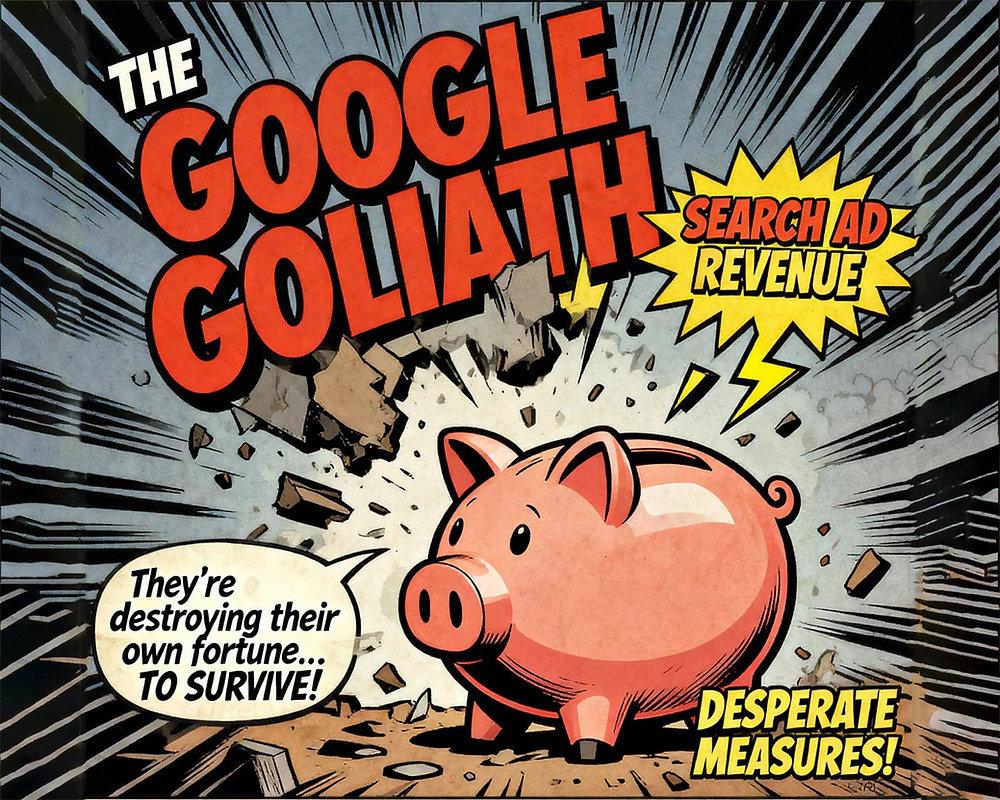
Google has informed me that my website contains “Low value content”. Meanwhile, its parent company Alphabet has watched $475 billion disappear from its stock market valuation in a single day. Naturally, I have a few bloody questions.
Well, there’s a turn-up for the books.
There I was, minding my own business, writing about politics, history, technology, society and whatever else happens to annoy me before breakfast, when Google AdSense delivered its considered opinion of my website.
Low value content.
Not moderately interesting content. Not content requiring improvement. Not even content that might benefit from fewer swear words and a more respectable pair of trousers.
No. Low value.
Apparently, the digital empire has examined my little corner of the internet and decided it isn’t sufficiently valuable to deserve the privilege of displaying its advertisements.
Fair enough. Their playground, their rules.
Then I opened the financial news.
Google’s parent company, Alphabet, had just suffered a stock market hammering of approximately $475 billion in one trading day.
And I thought: Well, bugger me. Which one of us has the value problem?
Nearly Half a Trillion Dollars and a Rather Awkward Thursday
On 29 October 2026, Alphabet shares plunged by almost 13%, following quarterly financial results that disappointed investors.
The headlines initially shouted about $500 billion disappearing. Yahoo Finance subsequently corrected its calculation to $475 billion.
That’s still an absolutely ridiculous amount of money.
To put it into perspective, I could probably buy a decent second-hand server with that. Possibly two, if I shopped around.
Now, before somebody starts composing an angry correction, Alphabet didn’t physically lose $475 billion from a bank account. Its market capitalisation fell because investors were suddenly prepared to pay considerably less for its shares.
I know the difference.
I’m writing satire, not applying for a job as the Chancellor of the Exchequer.
Nevertheless, the contrast is irresistible.
Here’s a company that helps determine what information billions of people encounter, what advertising appears beside it and whether small publishers qualify for its advertising programme.
And suddenly the financial markets have delivered their own assessment.
Value reduced. Considerably.
Perhaps Wall Street should have sent Alphabet a little automated message:
Your company currently does not meet our expectations. Reason: Low value growth.
The Artificial Intelligence Money Furnace
Much of the nervousness surrounded artificial intelligence.
Google has been spending enormous sums developing AI systems, building data centres and preparing for a future in which people might ask a chatbot a question rather than click through ten websites to find an answer.
Search advertising remains a substantial business, but its growth disappointed investors. Meanwhile, the cost of building the next generation of AI infrastructure has become eye-watering.
It’s an extraordinary situation.
For years, Google became enormously wealthy helping people find information produced by somebody else.
Newspapers, researchers, independent writers, hobbyists, businesses and countless ordinary people filled the internet with material.
Google organised it, indexed it and sold advertising around the resulting traffic.
A clever business model, certainly.
But now the company is spending fortunes developing systems that can provide answers directly, potentially reducing the need for people to visit the websites that helped make search useful in the first place.
And somewhere in that peculiar arrangement, the small publisher is still being told to produce more value.
More value for whom, exactly?
The reader? The advertiser? Google’s automated systems? Or the shareholders currently wondering where their enormous paper fortunes went?
Those are different questions, and pretending they’re identical is where the bollocks begins.
The Great Low-Value Content Tribunal
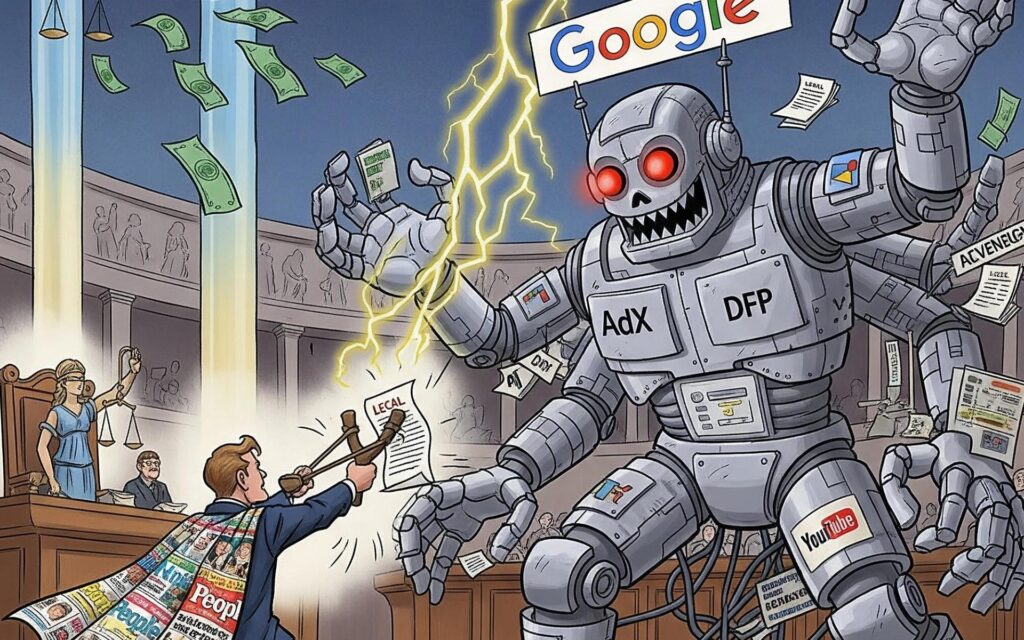
I would love to attend the meeting where somebody explains precisely why itsbigshit.com has insufficient value.
Picture the scene.
A spotless corporate office. Expensive chairs. A screen displaying charts nobody quite understands.
A senior executive announces that an independent British website has failed the company’s quality requirements.
“What’s wrong with it?” asks another.
“Well, it contains opinions.”
“Good heavens.”
“Some of them are rather strongly expressed.”
“Disturbing.”
“And occasionally the author says bloody, bugger or bollocks.”
At this point, somebody presumably faints into an ethically sourced cappuccino.
Of course, that’s imaginary. I have no evidence that a human reviewer even read my articles, let alone held a meeting about them.
And that’s part of the frustration.
An automated or standardised rejection tells you the category of the problem without necessarily explaining which articles caused it or what meaningful changes would put things right.
It’s like taking your car for an MOT and receiving a certificate saying:
“Vehicle insufficiently car-like.”
Thanks. Very helpful.
Does Everything Have to Sound Like a Corporate Instruction Manual?
I have a suspicion that the modern internet is becoming rather too fond of sameness.
Search for almost anything and you’ll find pages arranged in suspiciously familiar ways.
A cheerful introduction. Several tidy headings. A collection of obvious statements. A conclusion that repeats everything you’ve just read.
All beautifully polished.
All desperately keen to be helpful.
And sometimes about as interesting as reading the terms and conditions on a packet of toilet rolls.
There is nothing wrong with clear writing. There is nothing wrong with good organisation or factual accuracy.
But originality doesn’t always arrive wearing a suit and carrying a PowerPoint presentation.
Sometimes it arrives as an angry old bloke asking why the world has become such a peculiar bloody place.
Sometimes it challenges the reader. Sometimes it makes a joke that falls flat. Sometimes it expresses an opinion that half the audience thinks is nonsense.
That doesn’t automatically make it worthless.
Nor does it automatically make it valuable, for that matter.
A thousand words of badly researched rubbish remain badly researched rubbish, however passionately they’re written.
But surely the answer is to judge the substance rather than demand that every writer sounds as though they’ve been assembled in the same factory.
And Now the Robots Are Reading the Robots
Here’s another entertaining possibility.
AI can generate articles, advertisements, summaries, product descriptions and search answers at astonishing speed.
Publishers can use AI to produce material. Search engines can use AI to summarise that material. Automated systems can then assess whether the material is worth displaying beside advertisements.
Wonderful.
We’ve potentially invented an enormous digital machine in which computers manufacture content, computers inspect it, computers summarise it and computers decide how much commercial value it deserves.
Meanwhile, actual human beings are somewhere in the background wondering why nobody visits their websites anymore.
I exaggerate, naturally.
There are excellent uses for AI, including research assistance, accessibility, translation and helping people express ideas they might otherwise struggle to put into words.
But there is a difference between using technology to help somebody communicate and using it to replace the need for anybody to have something worth saying.
One assists human thought.
The other risks manufacturing industrial quantities of beautifully formatted nothing.
And I do wonder whether a search engine can always distinguish between the two.
The Little Website That Refuses to Wear a Tie
Now, I’m not pretending itsbigshit.com is some great national institution.
It isn’t the British Library.
It isn’t the Encyclopaedia Britannica.
It is a small, independent website containing articles, observations, arguments, satire and the occasional thoroughly unreasonable sentence.
Some readers will agree with me. Others will think I’m talking complete shite.
Excellent.
At least we’re having a conversation.
I don’t expect Google to approve advertising simply because I’ve written something. The company is entitled to standards, and readers deserve websites that function properly and provide something useful.
I’ll happily fix technical problems, improve navigation, correct mistakes and provide sources for factual claims.
What I won’t do is remove every trace of personality until the site resembles a corporate waiting room.
If a website called itsbigshit.com starts sounding like a committee-approved leaflet about responsible biscuit consumption, something has gone terribly wrong.
And if the problem is genuinely that the articles lack substance, tell me what needs improving.
Don’t just hand me a mysterious label and expect me to sacrifice a goat to the algorithm.
Perhaps Google Could Apply Its Own Standards
Here’s my modest proposal.
Whenever Google rejects a small publisher for low-value content, it should provide a useful explanation.
Not necessarily a detailed editorial report on every paragraph, but enough information to identify the actual issue.
Is the material insufficiently original? Are pages difficult to navigate? Is the site incomplete? Are there policy concerns? Are important pages inaccessible?
Give people something they can work with.
And while we’re discussing value, perhaps the great technology companies could apply a little more humility when judging the efforts of smaller creators.
After all, even the richest corporation can discover that the market’s opinion of its worth changes rather dramatically between breakfast and teatime.
That doesn’t mean Alphabet is suddenly a worthless business.
And Google’s rejection doesn’t prove my website is worthless either.
Value depends on what you’re measuring, who’s doing the measuring and why.
Dear Google, I’ve Got a Suggestion
I’ll continue writing.
Some articles will be serious. Some will be sarcastic. Some will probably contain language that would make a Victorian schoolmistress drop her knitting.
I’ll check my facts, challenge my own assumptions and occasionally discover that I’ve got something completely wrong.
When that happens, I’ll correct it.
Because that’s what independent writing ought to involve: curiosity, argument, mistakes, improvement and a willingness to question the people who insist they already know everything.
As for Google, I wish Alphabet’s shareholders a speedy recovery from their extraordinarily expensive Thursday.
Perhaps they’ll discover that the value of something cannot always be measured by the latest number flashing on a screen.
And perhaps Google will eventually decide my little website deserves a few advertisements.
Until then, I have one final suggestion.
Dear Google: I’ll work on my low-value content if you work on finding your missing $475 billion.
No rush.
I’ll put the kettle on.
And if you need somebody to explain the difference between value and bullshit, you know where to find me.
itsbigshit.com.
Apparently, the clue was in the bloody name all along.
“Dear Google, I’ll improve my low-value content when you’ve found your missing $475 billion. No rush. I’ll put the kettle on.”
Leave a Reply