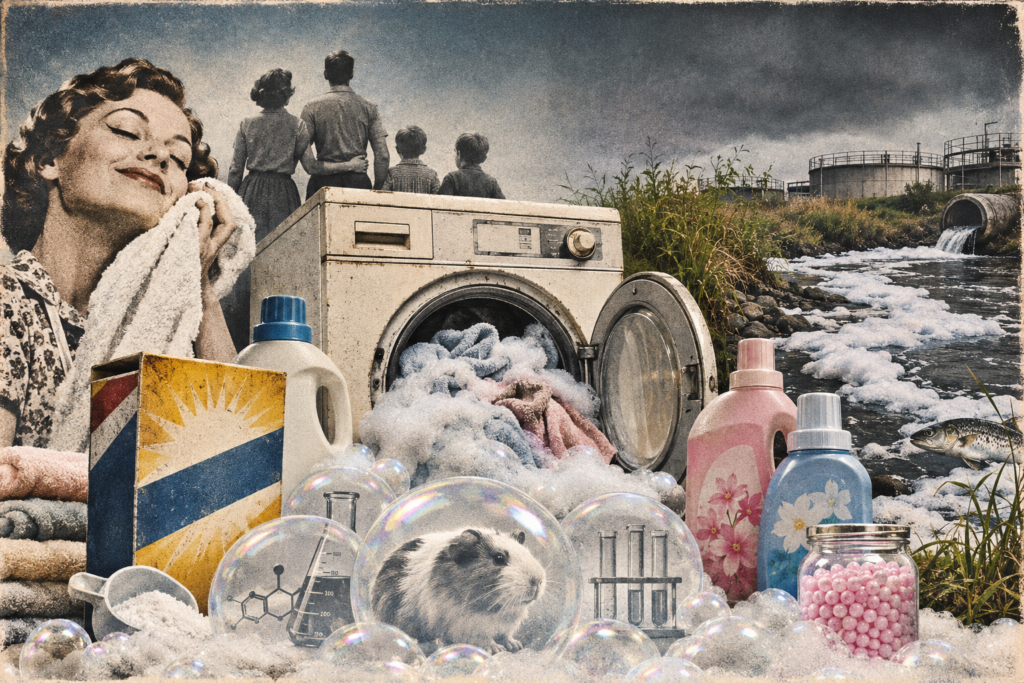
From a box of soap powder to a chemical cocktail in every wash. Seven decades of cleaner clothes, sweeter smells and a bloody enormous experiment nobody remembers volunteering for.
There was a time when washing your clothes was a fairly straightforward business. You got them dirty, you washed them, you dried them, and you put them back on.
Nobody expected their underpants to smell like an Alpine meadow for three weeks. Nobody needed little plastic capsules of concentrated chemicals, bottles of fabric conditioner, antibacterial additives, stain-removing sprays and expensive beads promising something called unstoppable freshness.
And yet here we are.
Seventy years later, the average supermarket laundry aisle resembles a small chemical warehouse dressed up as a garden centre.
Everything smells of lavender, mountain air, tropical sunshine or some other marketing department’s idea of what cleanliness should smell like.
But there’s a question that rarely gets asked.
What happens when millions of people spend their entire lives washing their clothes, bedding and towels in increasingly complicated chemical mixtures, wearing those fabrics against their skin, and sending the leftovers down the drain?
Not once or twice. Every week. Every year. From infancy to old age.
Are we actually making life healthier, or have we become the world’s largest collection of chemical guinea pigs?
The answer isn’t quite as simple as declaring every modern washing powder dangerous. Some formulations are demonstrably safer and environmentally better than their predecessors.
But that doesn’t mean the whole bloody business deserves a free pass.
1. How We Went From Washing Clothes to Perfuming the Population
In the 1950s, household washing products were already changing rapidly.
Traditional soap was increasingly replaced by synthetic detergents. Manufacturers discovered that specially designed chemicals could remove dirt and grease more effectively, particularly in hard water.
Then came enzymes, optical brighteners, chemical bleaching agents, fabric softeners and increasingly sophisticated fragrances.
Some changes were genuinely useful. Enzymes, for example, helped remove stains at lower temperatures, reducing the energy needed to wash clothes.
Others were less about cleanliness and more about selling us something we hadn’t previously considered necessary.
Fabric conditioner made clothes feel softer. Perfumes made them smell pleasant. Scent boosters made the smell last longer.
And suddenly a perfectly clean shirt wasn’t necessarily considered clean enough unless it smelled like an explosion in a flower shop.
The distinction matters.
Cleaning removes unwanted substances from fabric. Conditioning and perfuming deliberately leave substances behind.
That doesn’t automatically make them harmful. But it means the chemicals we buy aren’t necessarily all going down the drain.
Some are specifically designed to remain on the things we wear.
Which raises a perfectly reasonable question: why are we so comfortable adding chemicals to our clothing for cosmetic benefits, while knowing relatively little about the consequences of a lifetime of exposure to changing mixtures?
2. The Guinea Pig Nobody Asked to Be
Let’s be clear about something.
There is no credible evidence that detergent manufacturers are secretly running a coordinated human experiment.
But there is a much more uncomfortable reality.
New formulations enter the market after regulatory safety assessments, using toxicological data, exposure estimates and information about individual ingredients.
Those assessments are important. They prevent or restrict many genuinely dangerous substances.
What they cannot always provide is a complete picture of every possible interaction between numerous products used by the same person over decades.
Consider a perfectly ordinary household.
Someone showers using scented body wash, applies deodorant, puts on clothes washed with detergent and conditioner, sleeps in bedding treated with fragrance products, and cleans the kitchen with yet another selection of chemicals.
Each product may comply with its applicable safety requirements.
But who has studied every combination of those products, at every concentration, over an entire human lifetime?
Nobody has comprehensively tested every possible combination. In practice, it would be impossible.
That is not proof that the combinations are dangerous. It is a limitation of what safety testing can establish.
And it is precisely why long-term surveillance, independent research and proper regulation matter.
We are not literally laboratory animals.
But when products are used by millions of people for decades, their real-world use becomes an enormous source of evidence about effects that laboratory testing might miss.
The public is, in that sense, living inside a continuing chemical experiment — albeit one with safeguards, rather than one conducted without any testing.
3. The Human Skin: An Unwilling Chemical Testing Ground?
The skin is our largest organ, and it is rather good at keeping unwanted substances out.
But it isn’t an impenetrable brick wall.
Detergents, fragrances and preservatives can cause irritant or allergic contact dermatitis in susceptible people.
Some individuals develop redness, itching, cracking or inflammation following exposure.
Others can use the same products for years without any noticeable difficulty.
That difference is important because it makes sweeping claims about all detergents being harmful scientifically indefensible.
Nevertheless, the problem is real.
Fragrance ingredients are recognised causes of contact allergy. Certain preservatives used in liquid household products have also attracted regulatory scrutiny because of their potential to sensitise the skin.
And then there’s the question of unnecessary exposure.
Why should someone with sensitive skin need to navigate an increasingly complicated collection of fragrances simply to buy a product that washes their socks?
The industry has certainly developed fragrance-free and sensitive-skin products.
But their existence also demonstrates that manufacturers recognise a market for avoiding ingredients that some consumers cannot tolerate.
A clean pair of trousers doesn’t need to announce its arrival from the other side of the bloody room.
4. Fabric Conditioner: Selling Us Chemicals to Put Back Into Clean Clothes
Fabric conditioner deserves special attention.
Its primary purpose is not cleaning.
Most conventional conditioners use positively charged softening chemicals that attach to fabric fibres, reducing friction and static electricity.
Many also deposit fragrance.
Some modern formulations use fragrance microcapsules, designed to release scent when clothing is rubbed or handled.
Think about what that means.
We’ve reached a point where companies deliberately engineer microscopic structures to remain on fabric and release perfume during everyday wear.
It’s clever chemistry.
But clever chemistry isn’t automatically necessary chemistry.
Historically, some fabric softeners used compounds that were persistent and harmful to aquatic organisms.
Manufacturers subsequently moved towards alternatives, including esterquats, that generally biodegrade more readily.
That’s an improvement worth acknowledging.
However, the environmental behaviour of these chemicals still depends on their formulation, concentration and treatment after disposal.
And fragrance microcapsules introduce further questions about polymer particles and environmental persistence.
There is not enough evidence to conclude that wearing clothes treated with modern conditioners causes widespread chronic disease.
But there is enough reason to ask whether the environmental and exposure costs are justified by softer towels and longer-lasting perfume.
5. The Problem With Millions of Small Doses
Here is where the argument becomes more serious.
A substance can be hazardous without presenting a significant risk at the concentrations people normally encounter.
That’s basic toxicology.
But environmental pollution introduces a different question.
What happens when relatively small quantities are released by millions of households, repeatedly, into the same wastewater systems?
A single wash may contribute a tiny amount of a particular ingredient.
Multiply that by households washing several times a week, year after year, and the total quantities become substantial.
Wastewater treatment plants remove or break down many detergent ingredients.
Some substances, however, can pass through treatment, bind to sewage sludge or persist in the environment.
Aquatic organisms can be exposed to mixtures of pollutants from domestic sewage, industry, agriculture and other sources.
And although it would be wrong to blame laundry products for every polluted river, it would be equally wrong to pretend they make no contribution.
The environment doesn’t care whether a chemical arrived from a million washing machines or one industrial pipe. What matters is how much arrives, how toxic it is and what happens to it afterwards.
6. The Phosphate Scandal That Should Have Taught Us Something
One of the clearest historical examples involves phosphates.
For decades, phosphates were widely used in washing powders because they improved cleaning performance, especially in hard water.
Unfortunately, phosphorus entering rivers and lakes can encourage excessive growth of algae.
When that growth becomes severe, it can damage aquatic ecosystems and contribute to oxygen depletion.
The problem became sufficiently serious that restrictions were introduced.
In the UK and EU, phosphorus limits on domestic laundry detergents helped reduce one source of nutrient pollution.
That is a genuine environmental success.
But it also illustrates something uncomfortable.
A chemical can be enormously useful in a household product while creating serious problems when used on a massive scale.
And sometimes the full environmental consequences only become obvious after years of widespread use.
The lesson isn’t that every new chemical will turn out to be dangerous.
It’s that widespread commercial adoption should never be mistaken for proof of environmental harmlessness.
7. Cleaner Clothes, Dirtier Rivers?
Laundry pollution doesn’t stop with detergent ingredients.
Synthetic clothing releases microscopic fibres during washing.
Polyester, nylon and acrylic fabrics can shed plastic particles that enter wastewater systems.
Some are captured during treatment. Others can reach the wider environment, while captured particles may end up in sewage sludge.
The fibres come primarily from the textiles themselves, rather than from washing powder.
But detergent chemistry, washing temperature, mechanical agitation and fabric construction can influence shedding.
So the modern laundry system has created a complicated environmental problem involving chemicals, plastics, energy, water and textile manufacturing.
And what does the advertising tell us?
That our clothes will smell wonderfully fresh.
Not quite the same bloody conversation, is it?
8. The Fragrance Industry and the Smell of Marketing
Perhaps the cleverest achievement of modern laundry advertising has been convincing consumers that cleanliness has a particular smell.
It doesn’t.
Cleanliness means the removal of dirt, contaminants and unwanted substances.
Perfume is optional.
Yet entire product ranges are built around making fabrics smell stronger and for longer.
Some fragrance ingredients are allergens. Others can enter wastewater or contribute to indoor chemical emissions, although the health significance depends on the specific substance and exposure.
Research into fragranced products has identified volatile organic compounds released into indoor air.
But detecting a chemical does not, by itself, establish that it causes illness at the measured concentration.
This is where both industry marketing and environmental campaigning need to be challenged.
Manufacturers shouldn’t imply that more perfume means better hygiene.
Critics shouldn’t imply that every detectable chemical is a poison.
The real question is whether adding increasingly elaborate fragrance systems provides benefits proportionate to their possible health and environmental costs.
And, frankly, whether consumers are being sold a solution to a problem advertising invented in the first place.
9. What About Babies, Children and the Elderly?
One of the most important questions concerns people who may be particularly vulnerable.
Babies spend much of their time in contact with washed clothing, bedding and blankets.
People with eczema or damaged skin barriers can be more susceptible to irritation.
Older people may have more fragile skin, while people with certain respiratory conditions may find strong fragrances uncomfortable.
Does this mean modern detergents are poisoning these groups?
No. The available evidence does not support that sweeping conclusion.
But it does mean manufacturers and regulators should pay particular attention to realistic exposure among vulnerable people.
Children also face a different, well-established hazard from concentrated detergent capsules.
These colourful, highly concentrated products can cause serious injury when swallowed or when their contents reach the eyes.
That isn’t some hypothetical long-term risk.
It’s a recognised poisoning hazard introduced by a relatively modern product format.
And the irony is that much of the industry’s innovation is sold to us as convenience.
Sometimes convenience comes with consequences.
10. What About Our Pets and Wildlife?
Humans aren’t the only creatures sharing this chemical environment.
Dogs and cats sleep on washed blankets, walk across freshly cleaned floors and sometimes lick contaminated surfaces.
Detergents can cause irritation, and swallowing concentrated products can be dangerous.
The risk depends on the ingredients, quantity and route of exposure. A properly rinsed blanket is not equivalent to a dog swallowing a detergent capsule.
But outside the home, aquatic animals face a different problem.
Certain surfactants and fabric-softening chemicals are harmful to fish and aquatic invertebrates at sufficiently high concentrations.
Their real-world effects depend on how much reaches waterways and how effectively sewage treatment removes them.
The fact that a chemical is biodegradable doesn’t automatically mean it is harmless before it breaks down.
And the fact that something is diluted doesn’t mean its environmental contribution disappears.
We should be asking how much laundry-related chemical pollution reaches rivers, sediments and sewage sludge, and whether all those additional products are necessary.
After all, the fish didn’t ask for lavender-scented bloody river water.
11. If Everything Is Safe, Why Do Regulations Keep Changing?
Here’s a question that deserves a proper answer.
If chemical formulations are adequately assessed before widespread use, why do governments subsequently restrict certain ingredients?
The answer is partly that scientific knowledge improves.
New research can reveal previously unrecognised hazards, environmental persistence or exposure pathways.
Regulation changes accordingly.
That’s how a functioning safety system is supposed to work.
But it also means that approval today is not an absolute guarantee against discovering problems tomorrow.
Take intentionally added microplastics.
The European Union adopted restrictions in 2023, with transitional deadlines covering detergents and synthetic polymer particles used to encapsulate fragrances.
The rules generally apply to relevant detergent uses from October 2028 and fragrance encapsulation from October 2029, subject to the regulation’s definitions and exceptions.
These EU restrictions do not automatically apply identically in Great Britain.
Nevertheless, the regulatory development demonstrates that concerns about persistent synthetic particles are serious enough to justify intervention.
It doesn’t prove that every fragrance capsule causes human illness.
It does raise the question of why such materials should be released into the environment for something as trivial as making laundry smell stronger.
12. The Problem Nobody Can Easily Measure: A Lifetime of Exposure
Imagine a person born in 1955.
During childhood, their clothes are washed using the detergents available at the time.
As they grow older, formulations change.
Different surfactants appear. Enzymes become more sophisticated. Fabric conditioners become commonplace. Fragrance systems become increasingly elaborate.
Then come concentrated liquids, capsules and scent boosters.
By 2026, that person has lived through seven decades of changing household chemistry.
And here’s the awkward bit.
There is no comprehensive lifelong record of precisely which laundry ingredients that individual encountered, in what concentrations, and alongside which other household chemicals.
Nor is there a definitive study comparing the lifetime health outcomes of otherwise identical populations exposed to every historical and modern detergent formulation.
That doesn’t mean we know nothing.
We have toxicological studies, exposure assessments, clinical evidence, environmental monitoring and decades of regulatory experience.
But there are gaps.
And the more complicated our everyday chemical environment becomes, the harder it is to attribute an illness or environmental effect to one particular substance.
Absence of complete evidence of harm is not proof of perfect safety. But neither is incomplete evidence proof of hidden harm.
That is the distinction any serious investigation must preserve.
13. Are We Paying to Become Chemical Guinea Pigs?
Now we return to the original question.
Are human beings being used as guinea pigs?
Not in the literal sense of an unauthorised clinical experiment.
Modern detergents are regulated, tested and subject to restrictions.
But in a broader sense, society is participating in a continuous, uncontrolled experiment involving commercial chemical innovation and mass exposure.
Millions of households use products whose formulations change over time.
Consumers generally don’t understand the chemistry, and many would struggle to identify individual ingredients from a label.
They rely on manufacturers and regulators to assess the risks.
Meanwhile, scientists continue investigating environmental persistence, allergic reactions, chemical mixtures and possible long-term effects.
The industry profits immediately from selling its products.
Some environmental costs, however, may be shared by society, water companies, taxpayers and ecosystems.
That imbalance deserves scrutiny.
And so does the advertising.
We are encouraged to buy more products, use more fragrance and pursue ever-longer-lasting freshness.
But how often are we encouraged to consider whether a second, third or fourth laundry additive provides any meaningful benefit?
The marketing message is simple: more products, better washing.
The scientific answer is considerably more complicated.
14. Seventy Years Later, What Have We Actually Learned?
We have learned that phosphates can damage aquatic ecosystems.
We have learned that certain older surfactants and fabric-softening chemicals needed replacing.
We have learned that detergents and fragrances can cause irritation or allergies in susceptible individuals.
We have learned that concentrated laundry capsules create serious poisoning risks.
We have learned that synthetic textiles shed microplastics and that some intentionally added polymer particles warrant environmental restrictions.
We have also learned that modern detergent technology can clean effectively at lower temperatures, reducing energy consumption.
So no, everything hasn’t become worse.
But neither has every new development been an unquestionable improvement.
And perhaps the biggest change is psychological.
We’ve been persuaded that cleanliness requires a smell, softness requires another bottle, and freshness requires chemicals designed to remain on our clothes long after the washing machine has finished.
The ordinary act of washing has become an elaborate commercial ritual.
15. The Final Rinse: Who Benefits, and Who Carries the Risk?
Seventy years ago, washing clothes was about removing dirt.
Today, we’re sold an entire collection of additional treatments, fragrances and promises.
Some work extremely well.
Some are genuinely useful.
Others appear to offer little beyond a particular smell or feel.
And every unnecessary product has a manufacturing, packaging, transport and disposal footprint.
The important question is not whether every chemical is dangerous.
It’s whether we have allowed the pursuit of commercial convenience and artificial freshness to outrun our willingness to question the long-term consequences.
Are modern laundry products making the population progressively sicker?
There is not currently sufficient evidence to establish that as a general population-wide conclusion.
Are certain laundry chemicals capable of harming people, animals and the environment?
Absolutely. That is well established, although the likelihood of harm depends on exposure.
Can widespread use create environmental problems that are not obvious from looking at one household?
Yes. History has already demonstrated that.
And should we be asking harder questions about the lifetime exposure of millions of people to increasingly complicated household chemical mixtures?
Bloody right we should.
Because there’s something fundamentally absurd about spending billions developing products to make clothes smell like imaginary flowers while still having unanswered questions about the unnecessary chemicals we release into the world.
Maybe the future of laundry shouldn’t be another bottle, another capsule or another bloody fragrance booster.
Maybe it should be fewer unnecessary ingredients, better independent research, clearer labelling and products designed to clean clothes without leaving a chemical legacy.
After all, we’ve had seventy years to perfect the washing powder.
Surely by now we ought to be able to wash a pair of underpants without turning the whole business into a chemistry experiment.
Sources to link in the article
These are useful primary and scientific sources for keeping the article defensible:
- UK Health and Safety Executive — Detergent regulations and phosphate restrictions
- NHS — Causes of contact dermatitis
- Scientific review — Enzymes, detergents and skin
- EU Regulation 2023/2055 — Restrictions on intentionally added microplastics
Greyhat editorial note: This article distinguishes established toxicological and environmental hazards from suspected or incompletely researched long-term effects. It does not claim that ordinary use of all modern laundry detergents causes chronic disease or that manufacturers are deliberately conducting human experiments.
Leave a Reply