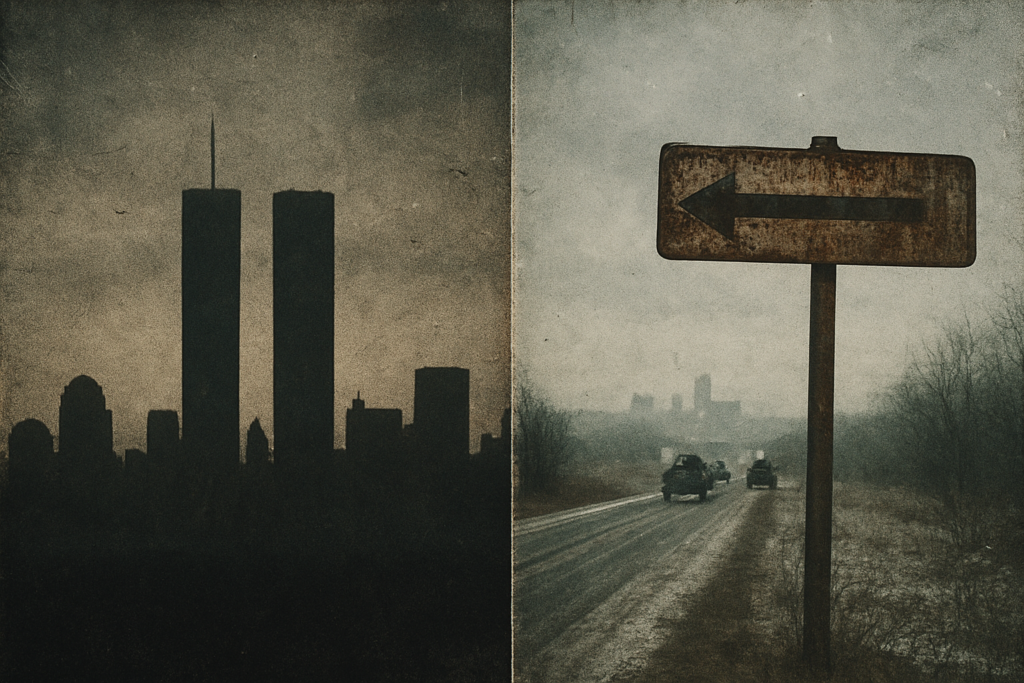
It’s unlikely Osama bin Laden got his big “clash of civilisations” idea from a Harvard professor’s essay in a 1993 issue of Foreign Affairs. But when al-Qaeda flew two planes into New York’s Twin Towers and hit the Pentagon eight minutes later, that’s basically what he ended up with: a story the world could understand, simplify, and then bleed to death over.
Samuel Huntington’s prediction that culture and religion would replace the Cold War as the main fault line has, for better or worse, pretty much set the tone for the last couple of decades. And unless we all suddenly get wiser, calmer, and less stupid, it’ll shape a lot of this century too.
The grim joke is it kicked off looking like a clean East vs West thing: Islam vs “the Christian world”, with America in the starring role and half the planet being told to pick a side.
Then, while the West was busy doing a lot of shouting and a lot of bombing, an old Cold War enemy watched and learned the obvious lesson: you don’t have to beat the United States in a fair fight. You just need to get it to punch itself in the face for twenty years.
A wound that turned into a doctrine
Right after 9/11, cooler heads in Washington might have been able to get revenge deliberately and surgically for the murder of 2,977 people. That number matters, because the horror mattered. The whole world watched the towers come down live on television. It didn’t feel like politics. It felt like the floor dropped out of modern life.
And that’s the point: bin Laden wasn’t a state. He was the millionaire failson of a rich Saudi family, hiding out in Afghanistan with a gang of mostly Saudi extremists and a talent for turning grievance into theatre.
George W. Bush reacted more or less how bin Laden would’ve hoped. Pain and outrage don’t make you wise. They make you loud.
The US invoked Article 5 of NATO for the first and so far only time in history. An attack on one NATO nation was treated as an attack on all, and suddenly a lot of countries were in a war to wipe out al-Qaeda and topple the Taliban, Afghanistan’s deeply conservative Islamist rulers.
The Taliban had no interest in global terror then. They’ve got none today either. That’s not a defence of them. It’s just what they are: brutal theocrats who want to run Afghanistan like a prison with prayers. But they did give bin Laden a safe haven, and in politics “guilty by association” has a long, enthusiastic career.
By the end of that year the Taliban had been felled. Bin Laden was reported fleeing the caves of Tora Bora near the Pakistan border. And America and its allies were leaning into a new military doctrine: pre-emptive killing.
You didn’t need to be a “ticking bomb”. You just had to be part of the movement that made them.
That’s a hell of a power to hand any government, especially one running on fear and vengeance.
Pre-emptive strikes, post-truth politics
The massive reaction to 9/11 created a new world disorder. Pre-emptive strikes in Pakistan and elsewhere became normal. Civilians died in extrajudicial killings. If you’re reading this and thinking “surely they had good intelligence”, sometimes they did. Sometimes they absolutely didn’t. The whole point of loosening the rules is you don’t have to prove as much.
And while the bombs were falling, a different message spread: America could be baited. America could be dragged. America could be made to look like the villain in somebody else’s story.
From the sophisticated madrassas of Pakistan, pushing hard-line Deobandi and Wahhabi flavours of literalism, to online forums and a few nasty little corners of diaspora politics in the West, young men were tempted by the black flag. Not because it was holy, but because it was simple. Because it offered a costume and a cause.
The uncomfortable truth is that Western overreaction helped sell that brand.
Iraq: the lie that fed the bonfire
Then came Iraq. The US invaded, and the UK followed under Tony Blair.
The West was lied into war. First: Iraq was developing a nuclear weapon. Second: Saddam Hussein was part of al-Qaeda’s agenda. Saddam was a brutal, secular dictator. He wasn’t an Islamist hero. If you’ve got even a scant understanding of Middle Eastern politics, you know Saddam’s regime and Islamist radicals were enemies, not mates swapping terror tips.
International law has always been imperfect and often used by the strong to punish the weak. Still, there was a sense the West, with the United Nations headquartered in New York, had helped build mechanisms meant to avoid war.
Iraq smashed that sense to bits. There was no proper UN mandate for an invasion. People around the world saw Iraqis getting shot at roadblocks by occupying troops, Western contractors hoovering up contracts funded by Iraqi oil revenue, and a system of near-impunity when civilians were killed and maimed. Call it “collateral damage” if you want. The families still had to bury it.
The “insurgents” were a messy mix: old Baathist thugs, Shia militias backed by Iran, and al-Qaeda elements. The clash of civilisations was now in full swing, fuelled by Western hypocrisy and the modern, online systems that radicalise and recruit.
One thing needs saying clearly, because people love to play the “both sides” game until the words mean nothing: Islamist terror is evil. It targets civilians on purpose. It’s not “resistance”. It’s murder with a religious costume.
But Western lies and Western brutality are also real. And they don’t cancel out Islamist evil. They just fertilise it.
Isis: politics of the worst people alive
Out of that chaos came the so-called Islamic State: a hybrid of Baathist tactics and radical ideology, running on spectacle and ultra-violence. It terrified a huge stretch of northern Iraq and Syria into submission.
The West and local allies fought back once Isis declared a “caliphate” and became a magnet for thousands of young idiots and sadists who wanted to belong to something that made them feel powerful.
By the end of 2017, Mosul and Raqqa had been recaptured by Syrians, Iraqis, Kurds and Western special forces support. Isis as a territorial project was finished. The ideology didn’t evaporate, but the statelet did.
Israel, Gaza, and the next wave
I’m pro-peace. I’m pro-Israel in the basic sense that Israel exists and isn’t going anywhere, and pretending otherwise is childish. I’m also anti-Netanyahu, because he’s a political arsonist who keeps finding matches in his pocket and acting surprised when things burn.
Islamist rage may yet return, partly driven by Israel’s actions in Gaza and the inaction of Israel’s allies in stopping the slaughter there. (If you want hard numbers and up-to-the-minute detail, you have to check current, reliable reporting. This stuff changes, and people lie about it constantly.)
None of that excuses antisemitism. None of it excuses terrorism. None of it excuses “global intifada” fantasists in safe Western cities who couldn’t find Gaza on a map but can find a slogan on TikTok.
But it does matter, because anger is fuel, and the internet is a petrol station open all night.
Meanwhile, Russia watched and waited
Another civilisation Huntington identified has been plotting and planning: Putin’s Russia.
Putin mostly stayed away from Middle Eastern quagmires, except backing Bashar al-Assad in Syria (the exact year and the precise shape of Russia’s escalation is something to verify if you’re pinning it to a timeline, because “backing Assad” spans more than one neat date).
What mattered was the wider arc: while America and its allies were spending lives, money, and credibility in Iraq and Afghanistan, Russia rebuilt its confidence and its nastiness.
Enraged by the expansion of Western democracy into eastern Europe, where states once under Moscow’s boot chose the EU and NATO instead, Putin invaded Ukraine in 2022. He dressed it up in mystical rubbish about Russia’s “soul” and Western plots. Strip away the poetry and it’s the old story: empire doesn’t like losing territory, or humiliation, or neighbours with choices.
He might have invaded anyway. But it helped that the West had already trashed its own moral authority in Iraq. When you’ve invaded a country without a proper mandate and on false pretences, it’s harder to stand on a podium and lecture someone else about law. You can still be right. You’re just easier to ignore.
The bill: money, bodies, and weakness
The “clash of civilisations” Putin has joined lately has already cost the US dearly. Brown University’s Costs of War project estimates the US spent $4.37 trillion on its wars in Iraq, Afghanistan and Syria. (If you’re quoting this publicly, check the latest figure and what exactly they include, because these projects update and the categories matter.)
Hundreds of thousands of human lives have also been squandered. That’s not a neat, comfortable statistic. It’s a long list of dead civilians, dead soldiers, shattered families, and broken places. It’s also the West, spiritually and politically poorer, deeply indebted, and now scrambling to meet new defence needs at the exact moment it can least afford complacency.
So yes, Putin has bin Laden to thank for part of this mess. Not because bin Laden “won” in any grand sense. He didn’t. He died in hiding like the coward he was.
But he did provoke the West into habits that made it weaker: panic legislation, forever-wars, moral double standards, and the normalisation of killing people because they’re in the wrong network.
What to do with this, besides scream
I’m anti-Putin because he’s a mafia-state imperialist with a flag. I’m anti-Islamism because it’s a death cult pretending to be piety. I’m pro-peace because the alternative is always a funeral, just with different uniforms.
And I’m not interested in the lazy, fashionable pose where you pretend the West is uniquely evil and everyone else is a victim. That’s not analysis. That’s just a new way to feel pure.
But I’m also not doing the other lazy pose where everything the West does is automatically righteous because the enemy is worse. If you only care about law and human life when your side is winning, you don’t care about law or human life. You care about your side.
What comes from the ass smells like shit, and when it comes from a cow, it is bullshit.
If you want fewer wars, you don’t get there by worshipping strongmen, or excusing terrorists, or pretending civilian deaths “don’t count” when they’re the wrong colour. You get there by being serious about borders, serious about defence, serious about truth, and serious about not lighting fires you can’t put out.
That’s it. That’s the whole miserable lesson.