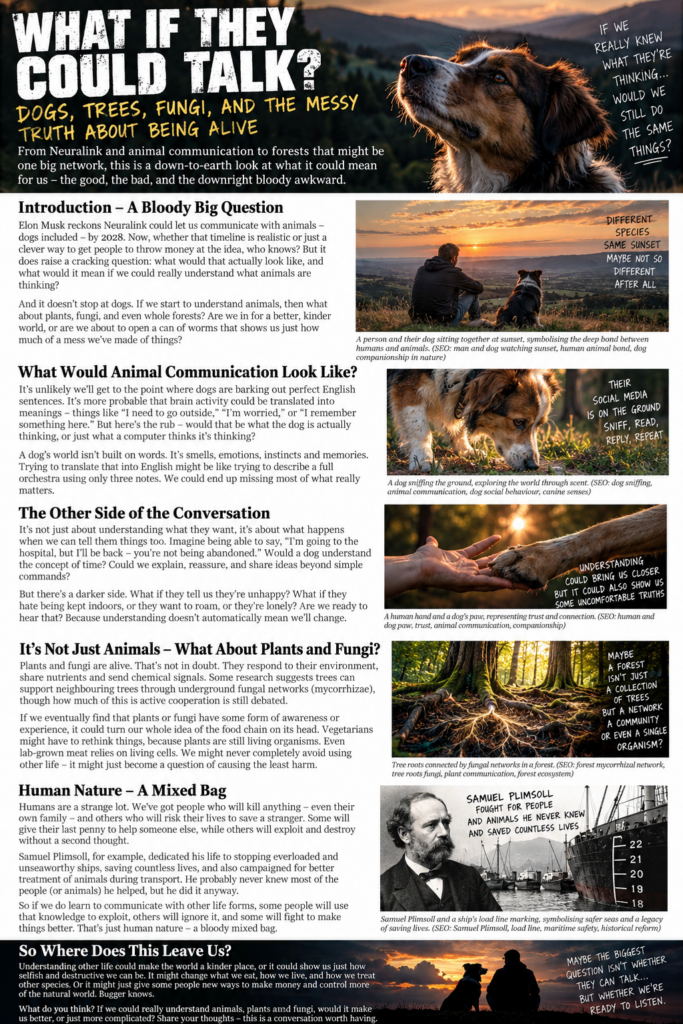
What if the problem isn’t that animals can’t talk to us? What if the problem is that, once they can, we won’t like what they’ve got to say?
Elon Musk reckons technology such as Neuralink could eventually allow humans to communicate with animals, dogs included. He’s even floated 2028 as a possibility.
Now, whether that happens in 2028, 2038 or sometime after I’ve shuffled off this mortal coil isn’t really the point. Musk has a habit of making rather ambitious predictions, and getting people excited about tomorrow is a bloody good way of attracting investment today.
But let’s put the sales patter aside.
Suppose it works.
Suppose one morning we wake up and discover that we can understand what a dog is thinking. Not just whether it wants feeding, needs a piss or fancies chasing the postman, but what it actually wants out of life.
Would that be wonderful?
Possibly.
Would it be a bloody nightmare?
Quite possibly that too.
And the more I’ve thought about it, the less convinced I am that humanity is ready for the answers.
Your Dog Has Been Using Social Media for Thousands of Years
I’ve had dogs for years, including rescue dogs that came into my life as adults. Watching them, especially those with a history I could only guess at, has taught me something.
They don’t need a mobile phone to find out what’s happening in the neighbourhood.
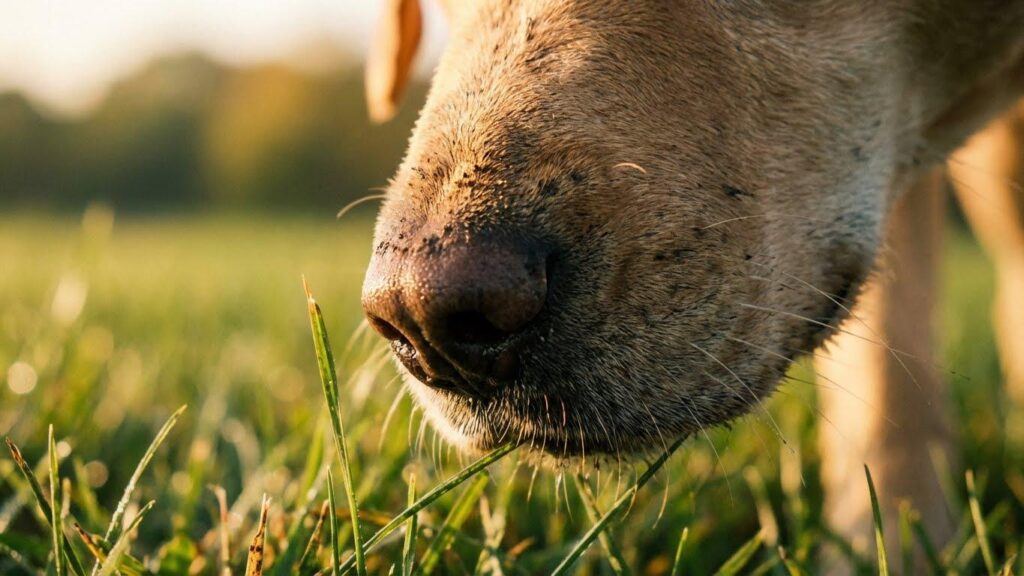
They’ve got their noses.
Take a dog for a walk and watch what happens. There’s a particular patch of grass, a lamppost or the corner of somebody’s garden that absolutely must be investigated.
We’re standing there thinking, “For fuck’s sake, you’ve sniffed that bloody post a hundred times.”
But the dog hasn’t necessarily encountered the same information a hundred times.
Another dog has visited. Perhaps several. Different scents have been deposited, some of which may reveal identity, sex, reproductive condition and other biological information.
And our dog comes along, has a good sniff, takes in whatever information it can, and sometimes leaves a little contribution of its own.
It’s Facebook without the keyboard.
Local Facebook, mind you. None of this getting into an argument with some bloke in Australia about what somebody in America said about a politician in France.
Just the local news.
Who’s been around? Who’s left a scent? Is there something new worth investigating?
Obviously, we don’t know precisely what a dog makes of every smell. I’m not suggesting they’re composing little messages about next Tuesday’s neighbourhood meeting.
But scent is a remarkably rich source of information, and dogs have access to a world that we humans barely notice.
Perhaps the first thing we should learn about communicating with animals is that they’ve been communicating perfectly well all along.
We’re just a bit bloody useless at understanding it.
What If Your Dog Doesn’t Like the Life You’ve Given It?
Here’s where things start getting uncomfortable.
Most dog owners love their dogs. I certainly love mine.
But loving something and understanding what it wants are two different things.
What if your dog could tell you it loves you dearly but absolutely hates being left alone for six hours?
What if it wants to spend half the day investigating the neighbourhood, meeting other dogs and doing whatever dogs naturally enjoy?
What if the perfectly behaved animal sitting quietly in your living room isn’t particularly happy, just well trained?
I’m not saying that’s true of every dog. Far from it.
But imagine having the ability to ask.
And imagine getting an answer you don’t particularly like.
Would we change our behaviour?
Some would. Some wouldn’t.
Some might even switch the bloody translator off.
That’s the uncomfortable bit about understanding another creature. Once you know what it wants, ignorance becomes a much harder excuse.
And Then There Are the Trees
Now, before somebody thinks I’ve been drinking something stronger than tea, bear with me.
Trees are rather more complicated than the lumps of wood standing in the garden.
Many form relationships with fungi living around their roots. These mycorrhizal fungi help plants obtain nutrients and water, while receiving sugars produced through photosynthesis.
Underground fungal networks can connect different plants, and researchers have demonstrated that substances, including carbon, can move between plants under certain conditions.
Some people call this the wood wide web.
I rather like that.

But we should be careful about taking the comparison too literally.
There are claims that trees deliberately feed sick neighbours, look after their children and operate as one enormous cooperative society. Some of those claims go considerably further than the evidence supports.
We know forests contain complex relationships involving cooperation, competition, chemical signalling and resource exchange. We don’t know that trees consciously decide to help their mates.
Still, there’s something remarkable about it.
What looks like a collection of separate trees is also a network of relationships, much of it hidden beneath our feet.
And what about the idea of a forest being a single organism?
In most cases, that’s not literally true. A forest is an ecosystem containing many organisms. Yet some individual organisms, such as certain clonal tree colonies and fungal networks, can spread over enormous areas.
So perhaps the boundaries between one living thing and another aren’t always quite as straightforward as we like to imagine.
Plants, Fungi and the Vegetarian’s Bloody Dilemma
Now we get to the bit that might upset a few people.
Vegetarianism and veganism are increasingly familiar parts of modern life. People make those choices for all sorts of reasons, including animal welfare, the environment, health and personal ethics.
Fair enough. Their choice.
But what happens if our understanding of plants and fungi changes dramatically?
Plants are alive. Fungi are alive. They detect changes in their surroundings, respond to chemical signals and can behave in extraordinarily complex ways.
Does that mean they think?
Not necessarily.
Does it mean they suffer?
We haven’t established that either.
There’s an enormous difference between responding to damage and consciously experiencing pain. A plant releasing defensive chemicals when attacked doesn’t prove it’s lying there thinking, “Oh bollocks, not another bloody caterpillar.”
But imagine, purely for the sake of argument, that future research discovers forms of awareness we’ve completely overlooked.
Where would that leave our food chain?
Would eating a carrot become a moral issue?
Would mushrooms be off the menu?
Would we start asking whether the cabbage had a decent life before somebody boiled the bugger?
It sounds ridiculous, doesn’t it?
But perhaps some of our present attitudes will sound equally ridiculous to people living a hundred years from now.
That doesn’t mean eating plants and animals is ethically identical. Even if plants turned out to have experiences, feeding crops to livestock generally involves using more biological resources than eating plants directly.
The question would become how to minimise harm, not how to pretend every choice has the same consequences.
And perhaps that’s where laboratory-produced food comes in.
Cultivated meat, fermentation-derived proteins and other food technologies might eventually reduce the number of animals raised and killed for food.
Although even laboratory food needs nutrients, energy and raw materials. We’re not going to escape the biological world entirely.
Life, it seems, has an annoying habit of depending on other life.
Perhaps We’ve Got Intelligence Completely Arse About Face
For centuries we’ve measured intelligence largely by how closely something resembles us.
Can it speak?
Can it count?
Can it use tools?
Can it recognise itself?
Can it solve a puzzle designed by a human who already knows the answer?
And when another creature doesn’t perform particularly well, we decide it’s not terribly bright.
Well, bugger me, perhaps we’ve been asking the wrong questions.
A dog can interpret scents that tell it things we’d never notice.
A migrating bird can navigate extraordinary distances.
Fungi respond to complex environmental conditions through their growing networks.
Trees detect environmental changes and adjust their physiology accordingly.
None of this automatically proves human-like intelligence or consciousness.
But it does demonstrate that living things have developed vastly different ways of interacting with their surroundings.
Perhaps the world contains forms of information processing that don’t fit neatly into the little boxes we’ve constructed.
And perhaps some of those boxes need kicking over.
Humanity: A Bloody Mixed Bag
Here’s why I’m not prepared to predict whether all this knowledge would make the world better or worse.
Human beings are an extraordinary mixture.
There are people who will murder another person for money, jealousy, revenge or some other miserable reason.
There are people who will abuse their own children, exploit vulnerable people or inflict suffering on creatures that cannot defend themselves.
And then there are people who will run into a burning building to save a complete stranger.
People who spend their lives caring for someone who can offer them nothing in return.
Parents who work themselves into the ground to give their children opportunities they never had.
People who will give away the last few quid in their pocket because somebody else needs it more.
And a million variations between those extremes.
Some people can be kind one day and cruel the next.
We’re not a species with one shared moral character. We’re a bloody complicated collection of individuals.
Which is why I don’t believe there’s going to be one grand human response if we discover that other living things possess far more awareness than we imagined.
Some will want to protect them.
Some will want to exploit them.
Some will simply shrug their shoulders and ask what’s for dinner.
We Didn’t Need a Translator to Understand Slavery
Consider slavery.
The people who enslaved other human beings didn’t need a brain implant to discover that their victims suffered.
They knew.
They knew enslaved people loved their families, feared punishment, wanted freedom and experienced pain.
And still slavery continued.
Why?
Money. Power. Convenience. Prejudice. The ability to convince ourselves that what benefits us must somehow be acceptable.
But there were also people who challenged it, fought against it and dedicated their lives to ending it.
That tells us something rather important.
Understanding suffering doesn’t automatically produce compassion.
Knowledge can help people challenge cruelty, but it doesn’t guarantee that cruelty will stop.
Which brings me to a Victorian gentleman who deserves rather more recognition than he generally receives.
Samuel Plimsoll: One Man Against the Bloody System
Samuel Plimsoll was born in 1824.
He became known for campaigning against dangerous and overloaded ships, often described as coffin ships, which could be sent to sea despite the risks to the sailors aboard.
Men were dying, and commercial interests could take precedence over their safety.
Plimsoll wasn’t prepared to accept that.
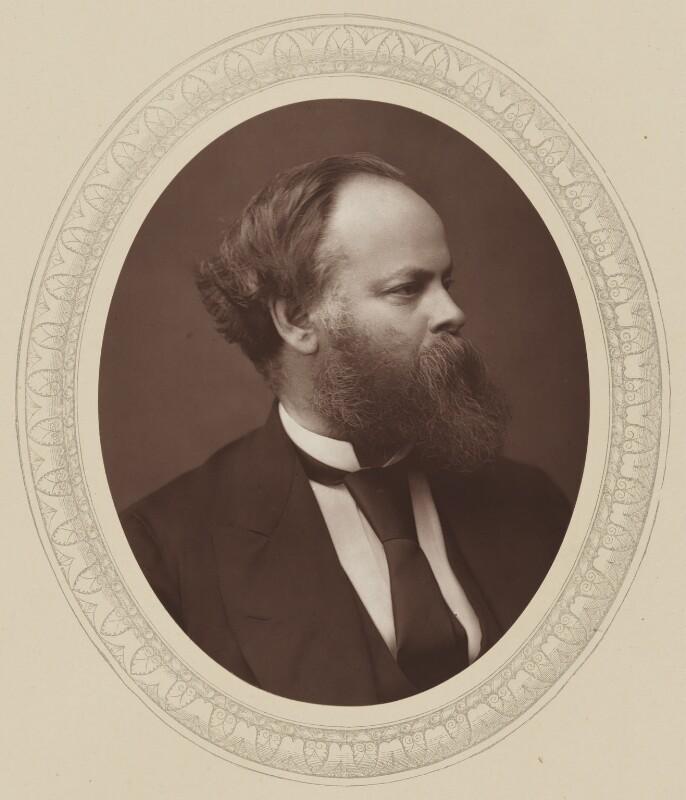
He campaigned, argued, made enemies and helped bring about reforms, including the Merchant Shipping Act of 1876.
His name lives on through the Plimsoll line, the load-line marking associated with how deeply ships may safely be loaded.
Think about that for a moment.
A man born more than two hundred years ago helped change maritime safety, and generations of sailors have benefited from reforms associated with his campaign.
Most of those sailors never knew him.
Many probably never gave his name a moment’s thought.
And he never knew the names of the countless people whose lives would be protected.
He also took an interest in animal welfare, including the treatment of animals transported by sea.
Now, that’s the sort of human being worth remembering.
Not because he was perfect. Nobody is.
But because he recognised something wrong and decided to do something about it.
He couldn’t save everyone, but he could make a difference.
And perhaps that’s all any of us can reasonably hope to do.
So What Happens When the Animals Finally Talk?
Let’s return to where we started.
Suppose Neuralink, or some entirely different technology, eventually gives us a meaningful way of communicating with other species.
Not a machine guessing that a dog wants its dinner, but something capable of revealing preferences, experiences and perhaps aspects of awareness we currently cannot access.
Some people would use that knowledge to improve animal welfare.
Others might develop better veterinary treatments or understand the needs of endangered species.
And some would undoubtedly look for ways to make money.
Imagine a farming system that could detect precisely when an animal was distressed.
That could be used to improve its welfare.
Or it could be used to work out exactly how much distress the animal could tolerate before productivity suffered.
Same knowledge.
Very different intentions.
The technology itself wouldn’t decide which path humanity took.
We would.
And if we discovered something equally remarkable about plants or fungi, the arguments could become even more complicated.
There would be scientific disputes, philosophical arguments, commercial interests, religious interpretations and probably some daft bugger on the internet insisting that his begonias had told him the winning lottery numbers.
That’s humanity for you.
Perhaps the Biggest Discovery Will Be About Ourselves
There’s one final thought I keep returning to.
We tend to think that understanding another creature would tell us more about that creature.
And it would.
But it might tell us rather more about ourselves.
How willing are we to change our behaviour when we discover we’ve caused unnecessary suffering?
How much inconvenience are we prepared to accept for the benefit of another living thing?
Does compassion stop when it becomes expensive?
Does it stop when the creature involved isn’t particularly attractive, cuddly or useful?
And who gets to make those decisions?
Scientists?
Politicians?
Corporations?
The people who own the technology?
Or the ordinary people whose lives and choices will be affected by whatever we discover?
I don’t have a neat answer.
Frankly, I’d be suspicious of anybody who claimed they did.
We haven’t even worked out how to treat one another decently after thousands of years of civilisation, so I’m not entirely convinced that giving us the ability to chat with a bloody oak tree would suddenly turn us into saints.
But neither would I dismiss the possibility of something wonderful coming from it.
There will always be people like Samuel Plimsoll, people who recognise injustice and refuse to leave it alone.
And there will always be others who see an opportunity to exploit somebody or something.
Perhaps the future will be decided by which of those people we choose to listen to.
Or perhaps that’s being too optimistic.
So here’s the question.
If tomorrow we discovered that dogs, pigs, cows, trees or fungi experienced the world in ways we’d never imagined, would it actually change how you lived?
Would it change what you ate?
Would it change how you treated your pets?
Would it change what you considered acceptable?
Or would you carry on much as before?
I’m not asking for the politically correct answer. I’m not even sure there is one.
I’m asking because I genuinely don’t know what I’d do with all that knowledge myself.
And I suspect quite a few of us would be in the same bloody boat.
Over to you.
Leave a Reply