Remember the1960s and70s? If you couldn’t sit still, write neatly, or shut the fuck up in class, you got the label: thick. Lazy. Awkward. “Not trying hard enough.”
Not a single adult stopped to ask why. No learning differences. No spectrum. No mention of dyspraxia, dysgraphia, autism none of that shit existed in the mainstream conversation. You were just broken, and everyone seemed fine with it. “Try harder.” “Sit down.” “Stop being difficult.” That was the entire support system, which was no support at all.
Fast forward to now, and we’ve got all the fancy words. Autism spectrum disorder. Developmental coordination disorder. Dysgraphia. Neurodiversity is in the cultural vocabulary, and some of us feel seen for the first time. But here’s the thing: the myth that “different” equals “dumb” is still walking around like an uninvited guest at a funeral. It’s got deep roots, and those roots were watered in classrooms where conformity was king and curiosity was a crime.
Let’s look at the old system for a second. Standardised tests. Rote memorisation. Read, write, arithmetic. You either fit the mould, or you got flattened by it. Couldn’t get your thoughts onto paper because your hand wouldn’t cooperate? That’s dysgraphia, but back then, you were lazy. Clumsy? Struggled with motor skills? That’s dyspraxia, but no, you were careless. Found social interaction absolute hell and spiralled into meltdowns when the sensory overload hit? You were just naughty, mate. Punished. Humiliated. Shut down.
And here’s the part most people don’t bother to think about: those kids grew up. They became adults. Elders, even. And they’ve spent decades carrying the belief that they were thick. So when they hear words like “autism” or “dysphoria” now, and they roll their eyes or say it’s all “fancy nonsense” don’t be so quick to call them ignorant. They’re not defending the old system. They’re defending themselves from it. A diagnosis feels like a luxury they never got. Worse, it rubs salt into the wound of everything they were denied.
That doesn’t excuse denial. But it explains it. And a bit of empathy goes a long way. When you talk to these people slowly, not patronisingly, just humanly, you often see the penny drop. They recognise the traits. They remember the kids in their class who were crushed like them. Some even feel relief, finally putting a name to what made their childhood such a slog.
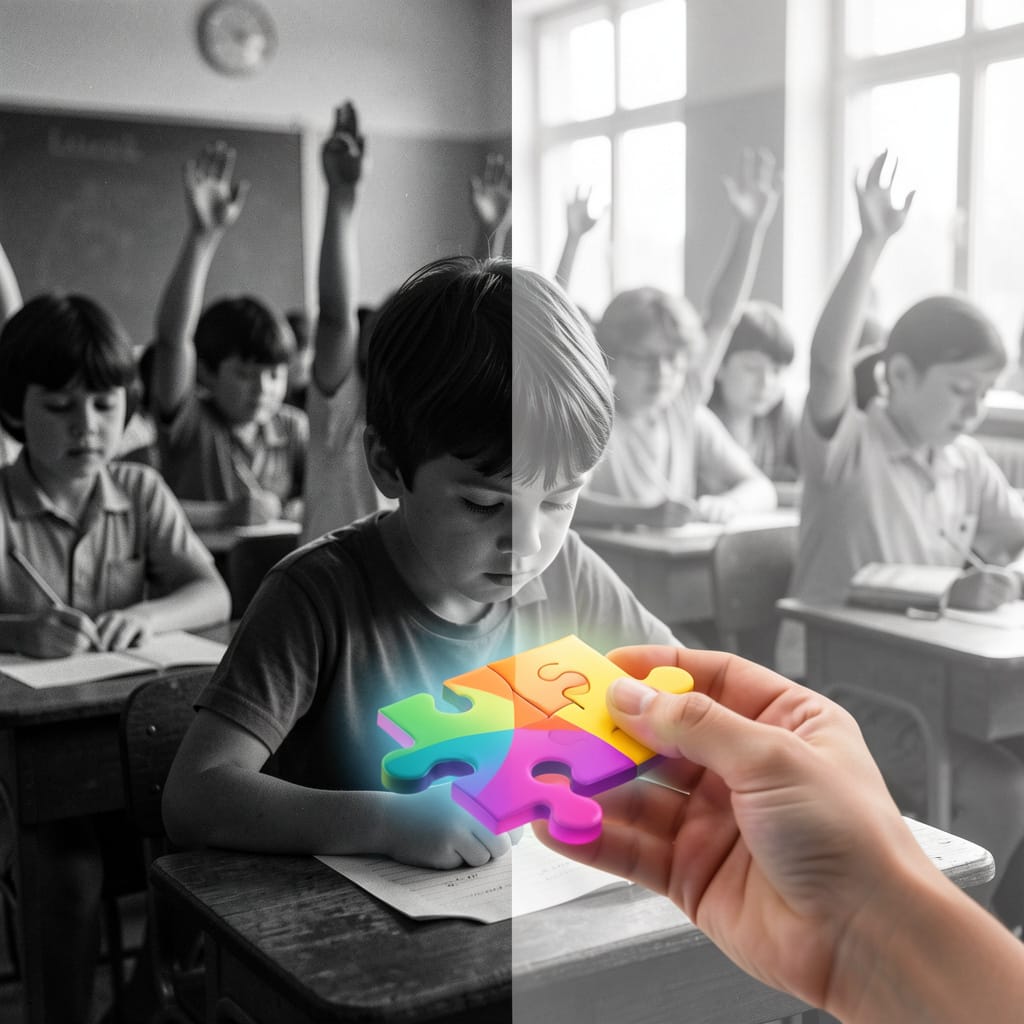
The myth of stupidity only survives in a world that worships sameness. But intelligence isn’t a single lane; it’s a whole fucking mosaic. Autistic people? Amazing pattern recognition, obsessive deep focus. Dysphasic people? Creative problem solvers, because they’ve had to navigate a world that wasn’t built for them. People with dysgraphia? Fantastic storytellers, even if their handwriting looks like a spider fell into an inkwell.
Busting this myth means rethinking what we call “smart.” It means acknowledging the old system was broken, not the kids in it. “Stupid” was never a truth about them. It was a verdict passed by a society that couldn’t be bothered to look closer.
So here we are. The good news: young people today get more support. The bad news: an entire generation is still walking around with shame they never earned. We owe them a rewrite. And not just for the kids now, for the old blokes and women who still think they don’t measure up.
They were never thick. They were failed. There’s a difference. And it’s about time someone said it.