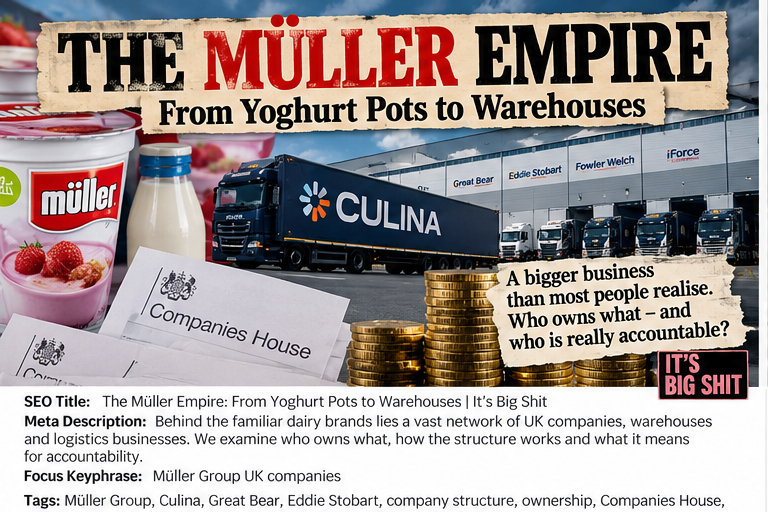
Behind the familiar dairy labels sits a much larger business empire. The question isn’t whether that empire is legal. It’s whether the public can see clearly enough who controls what.
Most people in Britain know Müller from the supermarket fridge. Yoghurt, milk, desserts. The sort of stuff you throw into a trolley without giving the ownership structure a second thought.
But follow the money beyond the dairy aisle and you find something rather bigger.
The German family-owned Unternehmensgruppe Theo Müller has interests in British dairy production and a substantial logistics operation through Culina Group. That brings familiar names such as Great Bear Distribution, Eddie Stobart, Fowler Welch and iForce into the wider corporate picture.
Suddenly we’re not just talking about yoghurt pots. We’re talking about warehouses, lorries, distribution centres, industrial estates and thousands of people earning their living moving goods around Britain.
And behind those operations sits a collection of limited companies, partnerships, holding companies and subsidiaries.
All perfectly ordinary in modern corporate Britain.
Which is precisely why we ought to pay attention.
A company inside a company inside another company
Companies House identifies TM Corporate Holdings UK Limited as a significant controlling company in the Culina structure.
Culina Group Limited is itself connected with numerous trading businesses. Great Bear Distribution Limited is a separately registered company. So are Eddie Stobart Limited, Fowler Welch Limited and others.
Each has its own legal identity.
That matters because the company whose name appears on a worker’s contract may not be the company ultimately controlling the wider business empire.
Limited liability is a legitimate and longstanding part of commercial law. It encourages investment and allows different operations to be managed separately.
But there’s a public-interest question that doesn’t disappear merely because a structure is legal.
When a business presents itself as one enormous group, how much responsibility should the group accept for what happens inside its individual companies?
If the parent celebrates the turnover, the acquisitions, the market share and the impressive fleet of lorries, should it also be expected to explain serious failures within its subsidiaries?
That’s not the same as saying the parent is automatically legally liable. It isn’t.
It’s asking whether corporate responsibility ought to be broader than the minimum obligation imposed by company law.
The legal name and the familiar name
Imagine a worker who spends years in a warehouse carrying a familiar brand above the entrance.
The worker might reasonably think they work for that business group.
Legally, however, their employer is the particular company named in their contract.
That distinction can matter enormously when something goes wrong.
A dispute over wages, a health-and-safety issue or an employment claim may involve one legal entity rather than the whole group.
And that can leave an ordinary employee trying to understand a corporate structure that even an experienced accountant might need a strong cup of tea to navigate.
None of this establishes that Müller created its structure to escape liabilities. The evidence examined does not establish that motive.
But the structure does raise a perfectly reasonable question: is corporate accountability as easy to understand as corporate branding?
The real ownership isn’t necessarily hidden
It would be wrong to suggest the ultimate ownership is secret. Public records identify significant parts of the structure, and Companies House provides information on company officers, filings and persons with significant control.
The problem is that information being publicly available is not the same as it being easy to understand.
A worker, customer or member of the public should not need to spend an afternoon digging through corporate filings to understand who sits behind a familiar warehouse or transport business.
Perhaps the answer is straightforward: major groups should publish a clear, accessible chart of their UK companies, their controlling entities and the responsibilities assigned to each.
Not buried in a document written for accountants.
On the website. In plain English.
The Greyhat question
There’s nothing inherently wrong with a successful family-owned multinational. Nor is wealth itself evidence of misconduct.
But scale brings influence, and influence ought to bring scrutiny.
The larger the corporate empire, the more important it becomes to distinguish the achievements advertised at group level from the legal responsibilities exercised at subsidiary level.
A business cannot reasonably expect the public to admire its size while insisting that every uncomfortable question must stop at the boundary of an individual limited company.
So here’s the question for Müller and every other sprawling corporate group operating in Britain:
If you’re proud to put the group’s name on the success, how clearly are you prepared to put that name alongside its responsibilities?
That’s not an accusation.
It’s a question the people working in those warehouses have every right to ask.
Leave a Reply