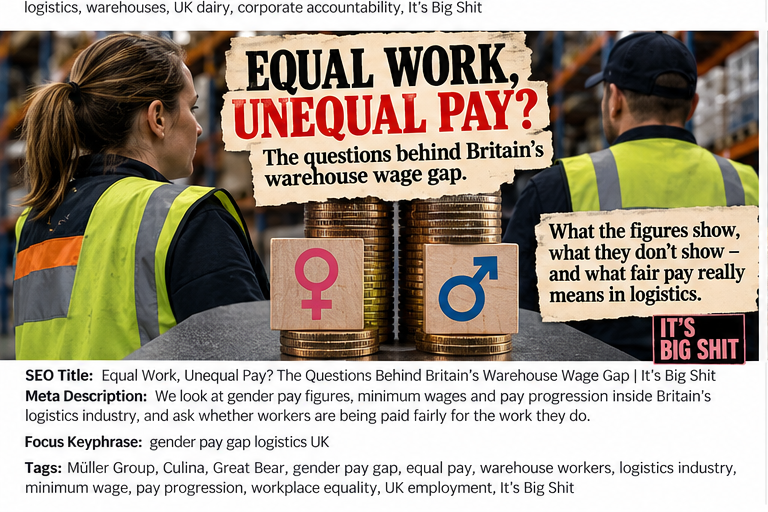
A business can publish its gender pay figures and still leave workers wondering whether everybody is getting a fair deal.
Britain has spent years talking about equality at work.
We’ve got legislation, reporting requirements, policies, training courses and enough corporate statements about fairness to wallpaper a distribution centre.
And yet one question remains wonderfully simple.
Are people being paid fairly for the work they do?
In warehousing and logistics, where jobs range from picking and packing to driving, administration and senior management, that question deserves a proper answer.
What the gender pay gap tells us
Large employers are required to publish information about differences in average hourly earnings between male and female employees.
The figures can reveal important patterns.
For example, a company may employ large numbers of women in lower-paid roles while men are more heavily represented in better-paid positions.
That can produce a gender pay gap even where men and women doing equivalent jobs receive the same hourly rate.
But there’s a crucial distinction.
A gender pay gap is not automatically proof of unlawful unequal pay or sex discrimination.
Equal-pay law concerns specific comparisons involving equal work and contractual terms. Gender pay reporting measures broader differences across an employer’s workforce.
Both matter, but they answer different questions.
Why the warehouse deserves attention
A distribution business might employ warehouse operatives, forklift drivers, transport planners, office staff, engineers, managers and directors.
Those jobs don’t all pay the same.
Some attract shift premiums. Some involve specialist qualifications. Others carry management responsibilities.
A useful investigation therefore needs more than a single headline percentage.
It needs to examine who occupies which jobs, who receives overtime, who gets promoted, how bonuses are distributed and whether progression opportunities are equally accessible.
And it needs to consider whether workers performing equal work are receiving equal contractual treatment.
What we know — and what we don’t
Great Bear Distribution appears in the government’s gender-pay reporting system.
That establishes that relevant pay-gap information is publicly reportable.
It does not, on its own, establish that Great Bear unlawfully discriminates against women or men.
The material examined so far does not provide a sufficiently verified set of current pay-gap percentages, occupational pay bands and equal-pay findings to support a declaration of unlawful sex-based wage discrimination.
So let’s not pretend otherwise.
Instead, let’s ask for the information that would allow a proper judgment.
How do the median and mean hourly pay figures compare?
What proportion of men and women occupy each pay quartile?
Who receives bonuses?
Are there differences in overtime access, promotion rates or shift allocation?
And what concrete action has the employer taken where significant gaps appear?
Minimum wage and fair wage are different arguments
A company can pay everyone above the legal minimum and still have substantial differences between its lowest-paid and highest-paid employees.
That isn’t necessarily unlawful.
But it is a legitimate subject for public debate, particularly in a large business where the lowest-paid workers may be essential to the operation.
Without the warehouse operative, nothing gets picked.
Without the loader, nothing gets loaded.
Without the driver, nothing gets delivered.
And without those people, the impressive turnover figures become rather academic.
The question for corporate Britain
I’d like to see large logistics employers publish clearer explanations of pay progression.
Not just a statement that they’re committed to equality.
Show the grades.
Show the routes to promotion.
Explain the shift premiums.
Explain how staff can challenge pay decisions without fear of retaliation.
And show what happens when a genuine inequality is discovered.
That would do rather more for confidence than another glossy paragraph about being a great place to work.
The Greyhat conclusion
I don’t believe a pay gap automatically makes a company sexist.
I do believe that a large company should be willing to explain its pay structure openly and address unjustified differences.
The burden of transparency shouldn’t fall entirely on a warehouse worker trying to work out why somebody else appears to be earning more.
Equality isn’t a slogan for the annual report. It’s something people ought to recognise when they open their wage packet.
Leave a Reply