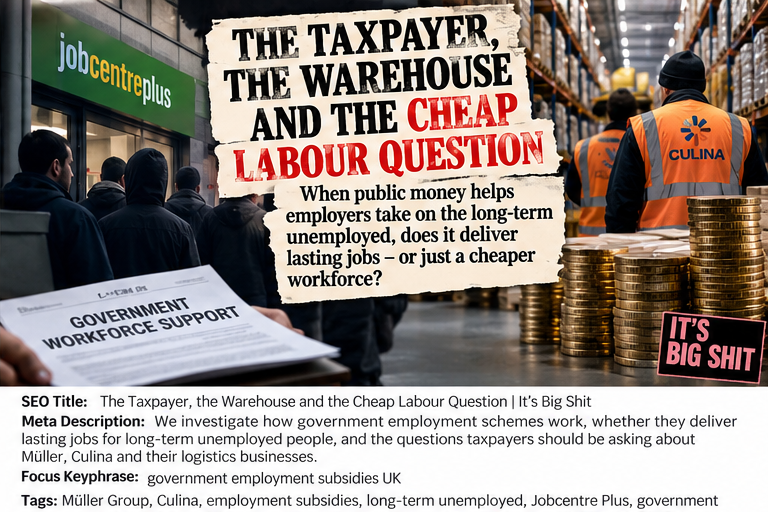
When the government helps employers take on unemployed people, is it buying a future for the worker — or merely reducing the company’s wage bill?
There’s something rather wonderful about the idea of helping someone who’s been unemployed for a long time back into work.
A wage, a routine, a bit of confidence, a reason to get up in the morning. Perhaps even the beginning of a proper career.
That’s what publicly supported employment schemes ought to deliver.
But there’s another side to the argument, and it’s one we should be prepared to examine.
When taxpayers’ money helps employers recruit, train or retain workers, who ultimately benefits?
The person getting a lasting job?
Or the company getting some of its employment costs paid for?
Public money isn’t a dirty word
Governments have used different employment-support schemes over the years, including programmes offering recruitment assistance, training support and, in some cases, wage subsidies.
These schemes aren’t all the same. Their rules, funding and eligibility change.
And not every company recruiting somebody who has been unemployed receives a wage subsidy.
That’s an important distinction.
There is no verified evidence in the material examined establishing that Müller, Culina or Great Bear currently receives a particular government payment for each long-term unemployed worker it recruits.
Nor is there evidence establishing that any of these businesses deliberately dismisses subsidised workers when payments end.
Those would be serious claims requiring payroll records, scheme contracts, recruitment data or credible testimony supported by documents.
But the absence of that evidence doesn’t make the wider policy question disappear.
What happens when the subsidy stops?
Suppose a government programme pays part of the cost of employing somebody for a limited period.
For a responsible employer, the assistance might make it possible to train a person who would otherwise struggle to get hired.
For a less responsible employer, the same arrangement could create an incentive to view employment as temporary financial arithmetic.
That is a potential weakness in the design of such schemes, not proof that a particular company exploits them.
The obvious safeguard is to examine what happens after the public support ends.
Are workers still employed six months later? Twelve months later?
Have they gained qualifications or moved onto better pay?
Or are they back at the Jobcentre while the employer recruits another subsidised intake?
Those are the figures the public deserves to see.
A low wage is not automatically an illegal wage
There’s another distinction worth making.
Paying the legal minimum wage is not, by itself, unlawful. Employers can comply with minimum-wage legislation while still offering jobs that leave workers struggling with rent, heating and food.
The legal minimum is a floor, not a certificate of generosity.
And a company can be highly profitable while employing people at relatively modest rates.
The real question is how the rewards of a successful business are distributed between shareholders, senior management and the people whose labour keeps it running.
We should also resist the temptation to claim that thousands of Müller-group workers are on minimum wage without payroll evidence.
Public workforce totals do not reveal the number of employees on the legal minimum, nor do they establish what individual workers take home.
If we want those answers, we need actual wage information.
The corporate welfare question
Here’s where my patience begins to wear thin.
We hear plenty about the responsibilities of unemployed people. They must apply for jobs, attend appointments, meet conditions and demonstrate that they’re doing their bit.
Fair enough.
But if the state offers financial assistance to employers, shouldn’t the employers face equally serious questions about what they deliver in return?
Not merely how many people started work.
How many stayed?
How many progressed?
How many received proper training?
How many ended up back on benefits?
And how much public money did the scheme cost for every lasting job created?
That’s not hostility to business. It’s basic accountability for public spending.
What Müller and Culina could disclose
For a group with extensive warehousing, manufacturing and transport operations, transparency would be particularly useful.
The public would benefit from knowing whether its UK businesses have participated in wage-subsidy or recruitment-incentive schemes, how much assistance they received, which programmes were involved and what employment outcomes followed.
There may be perfectly good answers.
If there are, publish them.
The Greyhat conclusion
I’m not against government helping people into employment.
Quite the opposite.
But I don’t want a system where the taxpayer carries the risk, the worker carries the uncertainty and the employer collects the benefit without meaningful scrutiny.
Public money should buy lasting opportunity.
Not just another impressive recruitment statistic for a corporate presentation.
If the government helps pay for the job, the government should make damn sure there’s a job worth keeping when the help runs out.
Leave a Reply