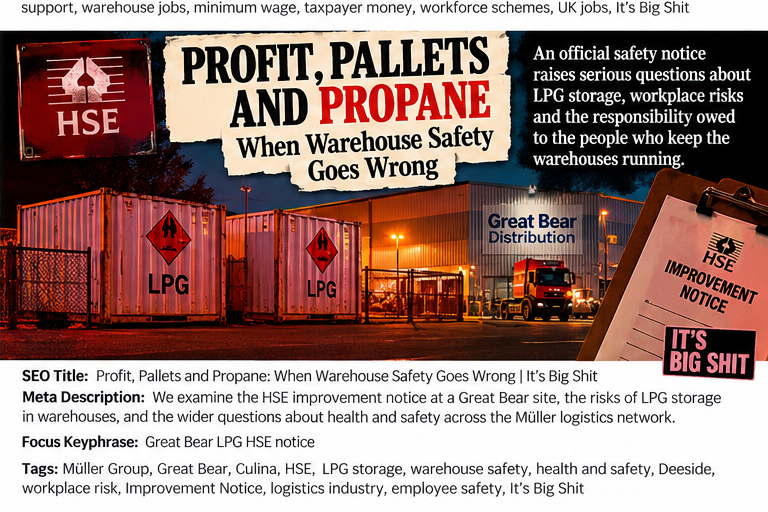
An official safety notice involving LPG storage at a Great Bear site raises a question every warehouse worker should be able to ask: how safe is the place where I earn my living?
A warehouse isn’t supposed to be an adventure playground.
You go to work, do your shift, earn your money and go home.
That last bit matters rather more than some corporate presentations seem to appreciate.
Because when dangerous substances are involved, a failure to control risks can have consequences far beyond a damaged pallet or a late delivery.
And in 2026, the Health and Safety Executive took enforcement action involving Great Bear Distribution Limited.
Two shipping containers and a serious risk
According to the HSE enforcement record identified in the research supplied for this investigation, an Improvement Notice was served on Great Bear Distribution Limited on 30 June 2026.
The location was Deeside Industrial Park in Flintshire.
The issue concerned large quantities of liquefied petroleum gas — LPG — stored in two shipping containers near loading bays.
The HSE considered the arrangements unsuitable and identified a risk of significant injury to employees from fire or explosion.
The notice cited section 2(1) of the Health and Safety at Work etc. Act 1974 and regulation 6(1) of the Dangerous Substances and Explosive Atmospheres Regulations 2002.
Those aren’t obscure technicalities.
They concern the basic responsibility to protect employees and control risks arising from dangerous substances.
The HSE record described in the supplied investigation identifies the notice as complied with, with a compliance deadline of 31 August 2026.
That compliance matters and should be acknowledged.
An Improvement Notice is also not the same as a criminal conviction.
But compliance after an enforcement notice does not make the original concern irrelevant.
The people nearest the danger
Think about who works around loading bays.
Warehouse operatives. Drivers. Yard staff. People loading and unloading vehicles, checking goods and keeping distribution moving.
These aren’t people who necessarily have any say in where hazardous materials are stored or how a site is designed.
They’re the people who must live with the consequences of those decisions.
And that’s why health and safety cannot be treated as a box-ticking exercise.
A risk assessment isn’t supposed to be a document that exists merely to satisfy an inspector.
It’s supposed to identify what could go wrong and what needs doing to prevent it.
The wider corporate connection
Great Bear is part of the Culina logistics structure within the wider Müller group.
That connection matters when discussing corporate oversight.
It does not mean the ultimate parent automatically committed the particular regulatory breach identified at Deeside.
The legal dutyholder named in the notice is important.
But it remains reasonable to ask what group-wide systems exist for sharing safety lessons, reviewing dangerous-substance storage and making sure similar risks are controlled at other sites.
Large groups often promote common standards across their businesses.
Safety ought to be among the most important.
One notice doesn’t tell the whole story
The wider research also identifies other regulatory cases involving companies associated with the Müller group, including historical workplace safety and environmental enforcement matters.
Those cases need to be examined individually.
A penalty against one subsidiary is not proof that every subsidiary operates unsafely.
Nor should an incident that predates an acquisition automatically be presented as misconduct committed under the current ownership.
But the records do demonstrate why group-wide safety performance deserves sustained scrutiny rather than a quick glance at the corporate website.
What workers deserve to know
Following a notice involving LPG storage, workers and the public have a legitimate interest in understanding what changed.
Were the containers moved?
Were storage quantities reduced?
Were separation distances or fire precautions improved?
Were risk assessments updated?
Were workers informed of the hazards and the controls introduced?
And were lessons shared with other facilities?
The enforcement record’s complied status is an important part of the answer, but the underlying corrective measures would give a fuller picture.
The Greyhat conclusion
There’s a peculiar habit in modern business of discussing risk as though it were mainly financial.
Market risk. Investment risk. Operational risk.
All very important, no doubt.
But to the person standing on a loading bay, risk can mean something much more immediate.
Fire.
Explosion.
Injury.
Not getting home.
And no amount of corporate turnover can make those possibilities acceptable when reasonably practicable precautions could prevent them.
I don’t know whether a particular manager ignored a warning, whether cost influenced the storage arrangements or whether anybody deliberately placed profit ahead of safety. The material examined does not establish those things.
What we do have is a reported official enforcement action that deserves public attention, together with recorded compliance.
The question isn’t whether a business can afford to take safety seriously. It’s whether the people working there can afford for it not to.
Leave a Reply