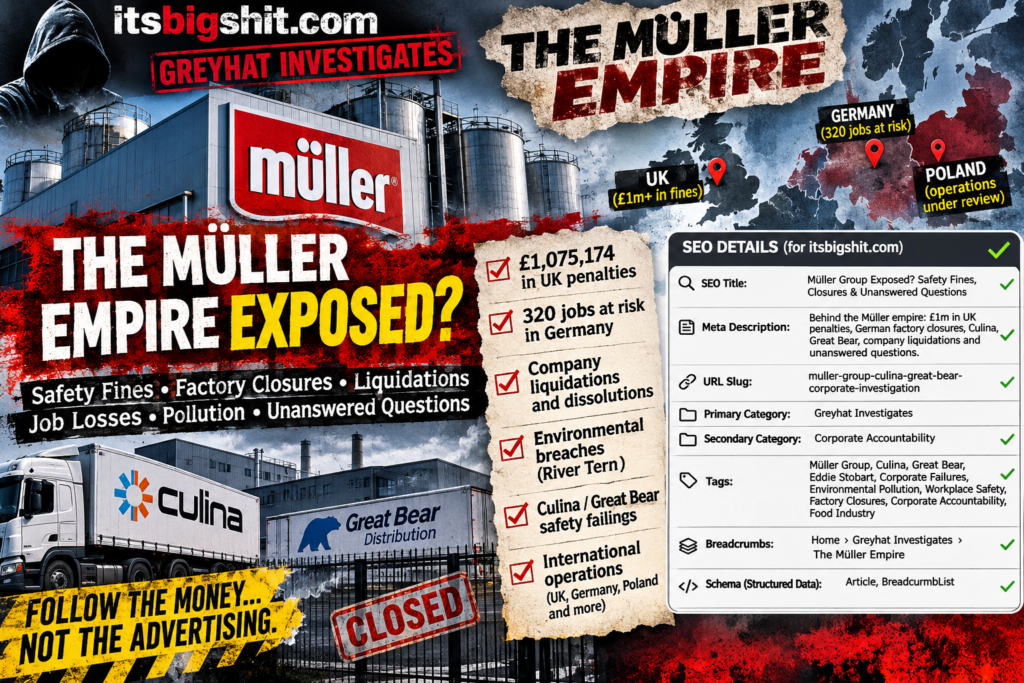
From milk bottles to massive warehouses, workplace safety breaches to factory closures — just how much do we really know about the businesses operating beneath the Müller umbrella?
Greyhat Investigates | 5 November 2026
The corporate cow has a lot more than four udders
Most people know Müller from the supermarket fridge. Yoghurts, milk, desserts and television advertising designed to convince us that a plastic pot of dairy goodness is one of life’s great achievements.
Lovely stuff.
But behind that familiar name sits a sprawling corporate empire, with operations stretching well beyond dairy products into distribution, logistics, warehousing and transport.
And once you start lifting the corporate carpet, you find rather more than a few crumbs.
You find companies within companies, businesses acquired from other businesses, subsidiaries with their own directors, accounts, employment arrangements and legal histories.
You find workplace safety enforcement, environmental penalties, employment-related cases, factory closures and thousands of workers whose livelihoods depend on decisions made somewhere above their heads.
You also find an almighty number of questions nobody seems particularly enthusiastic about answering.
Now, before somebody in a very expensive suit starts choking on their corporate coffee, let’s make something clear.
This investigation is not alleging that every Müller company has broken the law, or that corporate restructuring is automatically dishonest.
What we’re asking is rather simpler.
When an empire becomes this bloody big, who is keeping track of what happens inside it?
And when something goes wrong, who is ultimately accountable?
1. Müller, Culina and Great Bear: the corporate family tree
Müller is not simply a dairy company anymore.
Through the wider corporate structure, the group is connected with Culina, one of Britain’s major logistics operations.
Within that logistics structure sit businesses including Great Bear Distribution, Eddie Stobart, Fowler Welch, iForce and others.
According to Culina’s own modern slavery statement covering the financial year ending December 2025, its operations generated more than £2.2 billion in global turnover, used over 20 million square feet of UK warehousing space and operated approximately 3,000 commercial vehicles.
That’s not a little family operation delivering a few yoghurts in a Transit van.
That’s an industrial machine.
And an industrial machine needs workers. Drivers, warehouse staff, forklift operators, engineers, cleaners, agency workers, office staff and management.
People whose mortgages, families and futures depend on the machinery continuing to function.
The corporate structure matters because the name above the warehouse door isn’t always the name on the employment contract.
Nor is it necessarily the company that owns the property, holds the debts or answers for a particular legal obligation.
All perfectly possible within legitimate company structures.
But bloody inconvenient when somebody tries to understand where responsibility begins and ends.
Greyhat’s question: How many active, dormant, dissolved and previously acquired companies form part of the entire Müller corporate history, and how many have been examined for regulatory or employment problems?
So far, the answer is that a complete, independently reconciled register has not been established in this investigation.
2. Workplace safety: when the paperwork stops being funny
Let’s talk about something considerably more important than a yoghurt advert.
Not profits. Not corporate restructuring. Not executive bonuses.
People getting home from work in one piece.
In 2016, TM Telford Dairy Limited appeared in workplace safety enforcement records with a recorded financial penalty of £614,379, including associated costs.
That’s a substantial sum.
But the money isn’t the most important part.
The important question is what went wrong, what was changed and whether lessons learned in one part of the organisation were shared across the wider group.
Because a corporate safety policy is worth precisely bugger all if it looks beautiful in a boardroom but doesn’t protect the people working on the factory floor.
And this isn’t simply ancient history.
The Great Bear LPG incident
On 30 June 2026, the Health and Safety Executive served Improvement Notice 316046895 on Great Bear Distribution Limited at its Deeside premises.
The issue concerned large quantities of liquefied petroleum gas stored in two shipping containers near loading bays.
The HSE identified an unsuitable storage arrangement and a risk of significant injury to employees from fire or explosion.
The notice cited duties under the Health and Safety at Work etc. Act 1974 and the Dangerous Substances and Explosive Atmospheres Regulations 2002.
The public register records that the notice was complied with by 31 August 2026.
Good. It should have been.
But here’s the bloody question.
Why did the HSE have to identify the risk in the first place?
Were internal inspections carried out? Had anyone raised concerns? How long had the arrangement existed? Did management know? Were comparable storage arrangements checked at other sites?
We do not yet have the evidence to answer those questions.
Compliance with an improvement notice matters. But it doesn’t make the original risk disappear from history.
Nor should it make the questions disappear.
3. The penalties that don’t fit the shiny brochure
A search of Violation Tracker UK produces nine entries attributed to the Müller Group, totalling approximately £1.075 million in recorded penalties and related financial sanctions.
These include workplace safety, environmental, climate-related and employment matters.
Among the entries are:
- £614,379 — TM Telford Dairy, workplace safety, 2016.
- £268,586 — Müller UK & Ireland Group LLP, climate-related regulatory matter, 2025.
- £100,000 — Müller UK & Ireland Group Limited, environmental matter, 2023.
- £71,194 — Müller UK & Ireland Group LLP, workplace safety, 2016.
- £10,702 — Müller UK & Ireland Group LLP, labour standards, 2020.
- £6,280 — Müller Milk & Ingredients, employment-related matter, 2021.
The tracker contains further smaller entries.
These are historical records, not a finding that all those problems continue today. The figures also need reconciling against original enforcement decisions, and the tracker is not an exhaustive record of every company in the wider empire.
But even with those qualifications, the question remains.
How much of the public’s understanding of these companies comes from glossy corporate statements, and how much comes from reading the enforcement records?
A company can spend a fortune explaining its values.
An enforcement database tells you something rather different.
And unlike an advertising campaign, it doesn’t need a bloody jingle.
4. The workers: are they people or just numbers on a spreadsheet?
Modern logistics depends on flexibility.
That’s the polite word.
Workers may experience that flexibility rather differently.
Different shifts, different contracts, temporary labour, agency arrangements, changing locations and pressure to keep operations moving.
Culina’s own statement acknowledges using agency and subcontractor arrangements to accommodate changing customer demand.
That is not, by itself, evidence of wrongdoing.
But it raises legitimate questions about employment standards throughout a complicated supply chain.
Who actually employs each worker?
Who handles grievances?
Who is responsible for occupational health?
Who pays for safety training?
What happens when a worker becomes disabled or develops a long-term illness?
And how consistently are employment rights protected when different companies operate beneath the same corporate umbrella?
A policy written at group headquarters is one thing.
A worker trying to get somebody to answer an email about reasonable adjustments is quite another.
Greyhat wants to know whether there are recurring patterns in employment tribunal claims, particularly involving disability, sickness absence, disciplinary action, dismissal and reasonable adjustments.
Individual claims are not proof of corporate-wide misconduct. Nor does the existence of a tribunal case mean an employer has lost it.
But if similar complaints repeatedly appear across related companies, that would justify closer examination.
The investigation has not yet established whether such a group-wide pattern exists.
And that’s precisely why the tribunal records need examining properly rather than cherry-picking a couple of juicy headlines.
5. Government money: who’s paying for the workforce?
Here’s a subject that deserves a bloody enormous magnifying glass.
Governments operate employment schemes designed to help people into work, including people who have been unemployed for long periods.
There is nothing inherently wrong with that.
Helping somebody find work can be excellent public policy.
But when large employers participate in publicly supported schemes, taxpayers have every right to ask what they’re getting for their money.
How many Müller-related businesses have participated in wage subsidy programmes, employment incentive schemes, apprenticeships or publicly funded training arrangements?
How much money was involved?
How many jobs were genuinely additional?
How long did employees remain in work after the financial assistance ended?
Were any payments recovered for non-compliance?
And did any publicly supported jobs replace positions that would otherwise have existed without subsidy?
Those are questions, not allegations.
At present, this investigation has not established a verified group-wide figure for wage subsidies or the number of employees receiving the statutory minimum wage.
And that distinction matters.
Because claiming that thousands of workers are on minimum wage without payroll evidence would be making numbers up.
Greyhat has enough reasons to be suspicious of corporate opacity without inventing a load of bollocks to decorate the page.
6. Germany: when the factory gates close
The story doesn’t end at the English Channel.
In October 2026, reports emerged of planned closures affecting parts of Müller-linked production operations in Germany.
The changes involve approximately 320 jobs across two operations, including around 160 associated with the Homann Feinkost sauce factory in Rogätz.
The Rogätz closure is planned for 2027.
The stated commercial reasons include production costs, investment requirements and changing demand.
Those explanations may be entirely legitimate.
Businesses do sometimes become uneconomic.
But try explaining economic efficiency to somebody who has spent years working in the same factory and now faces unemployment.
A company sees a production line.
A worker sees a mortgage, a pension, a family and perhaps a town with precious few alternative employers.
What happens to the people?
Are alternative positions offered?
What redundancy arrangements are negotiated?
What happens to long-serving employees whose skills are tied to a particular factory?
And, crucially, what happens to the buildings, machinery, liabilities and suppliers when operations cease?
A closure announcement is only the beginning of the story.
The financial aftermath can continue for years.
7. Liquidations, dissolved companies and the creditors nobody puts in the advert
Now we arrive at one of the most interesting parts of this investigation.
Company closures and liquidations.
Because closing a factory, closing a business and liquidating a company are three different things.
A factory can shut while the legal company continues trading elsewhere.
A subsidiary can be sold.
A business can enter solvent liquidation after paying its debts.
Or it can become insolvent, leaving creditors to recover whatever the law and available assets permit.
None of those outcomes should automatically be described as fraud.
But when an international group buys, restructures, transfers and closes businesses, it becomes important to follow the financial trail.
Earlier research identified a Polish liquidation lead involving Walon Poland that requires further documentary verification before any firm conclusion about its relationship to Müller, its financial condition or creditor outcomes.
And that leads to a bigger question.
Across the entire Müller corporate history, have any companies been liquidated or dissolved while creditors remained unpaid?
If so, how much was owed?
To whom?
Were they ordinary commercial suppliers, landlords, workers, pension schemes or public authorities?
Were assets sold or transferred before closure?
Were those transactions independently valued?
Were there parent-company guarantees?
Were connected companies creditors or purchasers?
And did any business continue essentially the same activity under a different legal entity?
Again, none of those questions proves improper conduct.
But they’re exactly the questions a serious investigation should ask.
Because a corporate group can be immensely wealthy while an individual subsidiary has limited assets.
That may be perfectly lawful.
It can also mean that somebody owed money by one company has no automatic right to recover it from the richer parent.
And if you happen to be the small supplier waiting for payment, that distinction can be one hell of a nasty surprise.
8. Poland, Mexico and the international blind spots
The wider international picture remains incomplete.
Poland requires a proper examination of corporate registries, historic ownership, liquidations, financial filings and creditor notices.
Germany needs an entity-by-entity review of employment disputes, environmental enforcement, workplace safety and closures.
The UK needs a complete reconciliation of the Culina, Great Bear and Müller corporate structures.
And Mexico?
Previous research did not establish a verified Müller Group employer operating there or a substantiated link to Mexican drug trafficking.
An apparently relevant company name, Mueller de Mexico, was associated with the unrelated Mueller Industries.
That is precisely why similar company names cannot be treated as proof of common ownership.
If there are Müller-linked operations, subsidiaries, distributors or joint ventures in Mexico, they must first be identified through reliable ownership records.
Only then can employment, environmental or criminal enforcement records be meaningfully examined.
The same principle applies to any other country.
No guilt by geography.
No invented cartel connections.
No pretending a company is guilty because another business happens to have a similar name.
That’s not investigative journalism.
That’s throwing bloody darts at a map.
9. The corporate responsibility problem
Here’s the thing about enormous business groups.
They can present themselves as one great family when it comes to advertising, brand recognition and commercial strength.
But legally, each company may be a separate entity with its own responsibilities.
That distinction is not inherently wrong.
Limited liability is a fundamental part of modern business.
The problem comes when the public cannot easily work out who controls what, who owes what and who answers for what.
A warehouse worker might recognise the group logo.
A supplier might deal with a familiar trading name.
A customer might see one corporate identity.
But behind those names can be a collection of separate legal entities.
So here’s a simple proposal.
If a group is large enough to boast about its combined turnover, perhaps it should also be willing to explain its combined record on worker safety, employment disputes, environmental penalties, company closures and creditor outcomes.
Not merely what the law forces each subsidiary to disclose.
The whole bloody picture.
Because corporate responsibility shouldn’t stop at the boundary of whichever limited company happens to be convenient.
WHAT HAS NOT BEEN INVESTIGATED YET?
The unfinished business — and it’s a bloody long list
This is where the next phase of the investigation becomes important.
The work so far establishes specific enforcement records, a substantial corporate network and reported restructuring. It does not establish a complete history of the group’s conduct worldwide.
The following areas remain outstanding.
A. Corporate ownership and financial control
- A complete worldwide list of current and former subsidiaries, including dormant and dissolved companies.
- The acquisition and disposal dates of each company.
- Parent-company guarantees, intercompany loans and material related-party transactions.
- Historic directors and ownership changes.
- Whether significant liabilities were transferred between related companies.
B. Closures, insolvencies and unpaid creditors
- Every confirmed administration, liquidation, insolvency and dissolution involving a relevant company.
- Creditors’ reports, statements of affairs and available dividend records.
- Whether employees, suppliers or public bodies were left with unpaid claims.
- Any relevant asset transfers before insolvency, with their dates and valuations.
- Whether insolvency practitioners or regulators identified misconduct or challenged transactions.
C. Employment and workers’ rights
- A complete search of published employment tribunal judgments for all verified UK subsidiaries.
- The outcomes of cases involving disability discrimination, unfair dismissal, whistleblowing and reasonable adjustments.
- Available equivalent employment judgments in Germany, Poland and other confirmed operating countries.
- Employee numbers, agency labour use, wage distribution and turnover by subsidiary.
- Whether similar complaints recur across companies, distinguishing allegations from established findings.
D. Safety and environmental enforcement
- All HSE improvement and prohibition notices, convictions and relevant historic records, including records no longer on the five-year public notice register.
- Environment Agency permits, enforcement undertakings, prosecutions and other sanctions.
- Comparable overseas regulatory decisions.
- Whether safety failures identified at one site were checked for at other sites.
- The underlying circumstances, corrective actions and repeat-offence history behind recorded penalties.
E. Taxpayer funding and public contracts
- Government employment subsidies, grants and training payments received by each company.
- Apprenticeship funding and other publicly supported workforce programmes.
- Public procurement contracts and their values.
- Compliance checks, clawbacks and any established funding breaches.
- The number and duration of jobs demonstrably supported by public money.
F. International operations
- Full ownership verification across continental Europe and any operations outside Europe.
- Detailed investigation of the Polish liquidation lead and other historical corporate closures.
- Environmental, labour and safety records in every verified operating country.
- Confirmation of any actual Müller Group operations or ownership links in Mexico before investigating local allegations.
- A country-by-country comparison of regulatory outcomes, creditor protections and employment standards.
Thirty areas of unfinished business.
And some of those areas contain hundreds of individual records.
That’s not a quick Google search and a cup of tea.
That’s a substantial corporate investigation.
THE GREYHAT VERDICT: THE BIGGER THE EMPIRE, THE BIGGER THE QUESTIONS
Nobody sensible expects a business employing thousands of people to operate for decades without disputes, mistakes, accidents or commercial failures.
That would be ridiculous.
But there is a world of difference between accepting that problems occur and deciding nobody should examine them.
Müller and its associated businesses are entitled to defend their records, explain their decisions and correct anything inaccurate.
Workers, suppliers, creditors and taxpayers are equally entitled to ask difficult questions.
The documented penalties deserve scrutiny.
The workplace safety notices deserve scrutiny.
The employment record deserves scrutiny.
The closures deserve scrutiny.
And the financial treatment of creditors when companies disappear deserves particularly close scrutiny.
Because the corporate world has a wonderful habit of celebrating success collectively while explaining failure through the fine print of individual legal entities.
When business is booming, everybody belongs to the family.
When the bill arrives, suddenly it’s a different limited company.
That’s a general problem with corporate accountability, not a finding that Müller has deliberately used such arrangements to evade debts.
But it is a bloody good reason to investigate.
The central question is no longer simply how large the Müller empire has become.
It’s whether its public accountability has grown at anything like the same speed.
And until somebody has followed the ownership records, the money, the employment judgments, the enforcement notices and the liquidation paperwork, the full answer remains unknown.
Not guilty by assumption.
Not innocent by advertising.
Just a very large corporate empire with a very large number of questions still waiting for answers.
And Greyhat isn’t particularly interested in being told to stop asking.
Because if the corporate house is genuinely in order, opening the books ought not to be such a terrifying bloody prospect.
Greyhat — itsbigshit.com
The most important findings are supported by these records:
- Violation Tracker UK — nine records totalling £1,075,174. violationtrackeruk.goodjobsfirst.org
- River Tern pollution — £100,000 environmental undertaking. violationtrackerglobal.goodjobsfirst.org
- 2025 emissions permit penalty — £268,586. violationtrackeruk.goodjobsfirst.org
- Müller’s official announcement — German factory closure. Home
- German reporting — 320 jobs affected across two operations. t-online
- Companies House — Culina Group accounts and ownership filings. GOV.UK
- Companies House — Great Bear Distribution accounts. GOV.UK
Leave a Reply