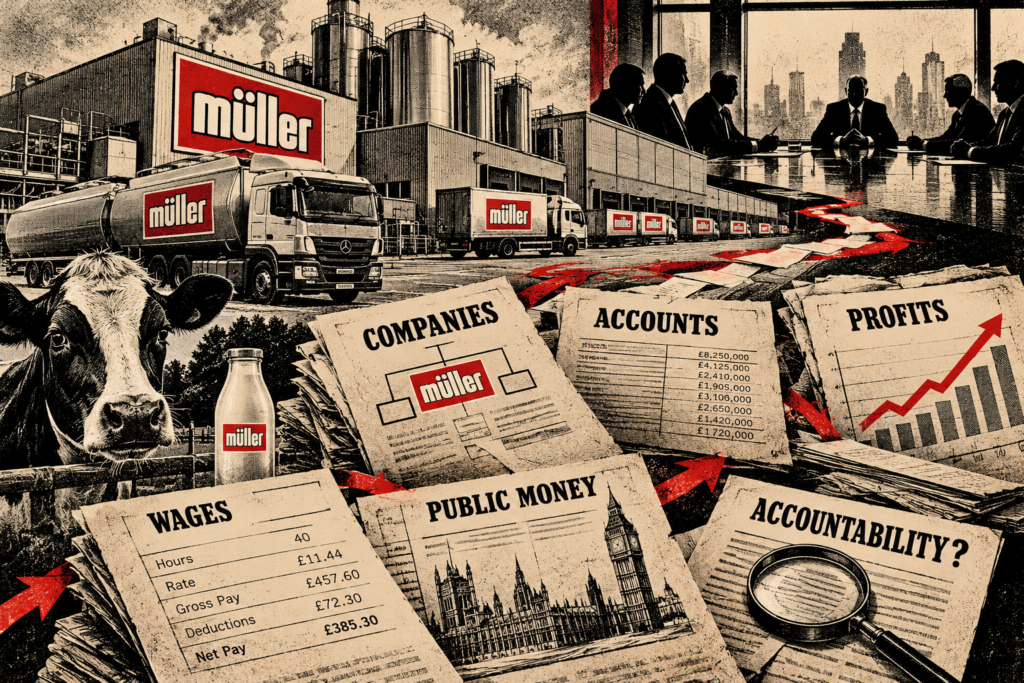
# The Müller Paper Trail: Follow the Companies, Follow the Money, Ask the Awkward Questions
**From supermarket yoghurt to British warehouses, the Müller business empire stretches much further than the average shopper might imagine. Now the company records are giving us another reason to look more closely.**
*By Greyhat | itsbigshit.com | 13 October 2026*
—
## There’s a Lot More Behind That Yoghurt Pot
Walk into almost any British supermarket and you’ll find Müller products sitting in the chilled section. Yoghurt, milk, desserts — ordinary products bought by ordinary people.
But behind the familiar branding sits something considerably larger.
Warehouses. Distribution centres. Lorries. Logistics contracts. Thousands of workers keeping goods moving around the country.
And somewhere within that sprawling operation are companies with names the average shopper might never recognise.
Culina Group. Great Bear Distribution. Culina Asset Management. And plenty of other names deserving examination.
The question isn’t whether a large company is entitled to own other companies. Of course it is.
**The question is whether the public can properly see how those businesses operate, how their workers are treated, and where responsibility lies when something goes wrong.**
Because a corporate structure should explain responsibility, not make it disappear.
## Start With the Companies House Records
Let’s begin with something that isn’t speculation.
Great Bear Distribution Limited is a registered British company, number **02899719**, incorporated on 17 February 1994.
Its declared business activity is warehousing and storage for land transport.
Companies House records identify Culina Group Limited, company number **05525931**, as a person with significant control over Great Bear, with ownership of at least 75% of its shares.
That gives us a documented relationship between the two companies.
It does not, by itself, establish that Culina made every operational decision taken at Great Bear, or that another company automatically carries legal liability for everything Great Bear does.
Those distinctions matter.
But it does establish something worth following: Great Bear is not simply an isolated warehouse business with no wider corporate connection.
It sits within a larger ownership structure.
And that means the investigation cannot sensibly stop at the warehouse gates.
## The Accounts: Where the Interesting Questions Begin
Company accounts aren’t exactly bedtime reading.
Unless, of course, you’re interested in where the money goes.
The latest filings need to be examined carefully, particularly for information about employee numbers, staff costs, profits, related-party transactions and financial obligations.
Those figures can help us understand how a business operates financially.
But they also have limitations.
A company’s average staff cost does not tell us precisely how much an individual warehouse worker earns. It may include management salaries, employer pension contributions, National Insurance and other costs.
Likewise, a profitable company isn’t automatically breaking the law by paying workers the statutory minimum wage.
Nevertheless, when a business is part of a substantial corporate group, questions about wages, working conditions and the distribution of profits are entirely legitimate.
How many employees are there across the UK group?
How many are paid at or close to the legal minimum?
How many are employed directly, and how many through agencies?
What proportion of staff costs relates to warehouse workers rather than senior management?
These are not accusations.
They are questions that deserve proper answers.
## Public Money and Private Employment
One area of our investigation concerns government-backed employment programmes.
Over the years, governments have introduced schemes intended to help people who are unemployed, including those who have been out of work for long periods.
Some programmes have offered employers financial support, training assistance or wage subsidies.
In principle, there’s nothing wrong with that.
Helping someone return to employment can benefit the individual, the employer and the taxpayer.
But it raises an obvious question.
**If public money helps a private business recruit workers, what does the public receive in return?**
Are those jobs permanent?
Are workers given meaningful training?
Do they remain employed after any subsidy ends?
And have companies within the wider Müller and Culina structure participated in such schemes?
At present, we have not established a complete, verified list of payments to individual group companies.
It would therefore be wrong to claim that Great Bear, Culina or another named business has received particular wage subsidies without documentary evidence.
But checking government grant records, procurement information, programme disclosures and company accounts is a perfectly reasonable next stage.
After all, taxpayers are entitled to know how their money is used.
## Health and Safety: A Warehouse Isn’t Just a Big Shed
Anyone who has worked around industrial premises knows that a warehouse is not necessarily a harmless environment.
There may be forklifts, heavy vehicles, loading bays, machinery, combustible materials, compressed gases and workers moving around under considerable pressure.
The Health and Safety Executive maintains public registers of enforcement notices and convictions.
These are important sources, but they need to be interpreted correctly.
An improvement notice, a prohibition notice and a criminal conviction are not interchangeable.
An improvement notice generally requires action to remedy a legal contravention.
A prohibition notice concerns an activity presenting a risk of serious personal injury.
A conviction follows criminal proceedings.
And an incident or allegation, however troubling, does not automatically establish that the law was broken.
Our investigation therefore needs to examine each relevant legal entity separately, identify the location and date of any enforcement action, and establish whether the company was part of the Müller group at the time.
That last point is particularly important.
**You cannot fairly blame a company for an event that happened before it acquired the business without examining the legal circumstances.**
Equally, a change of ownership shouldn’t become an excuse for ignoring problems that continued afterwards.
## Employment Tribunals: Read the Judgment, Not Just the Headline
Another important area is employment law.
Across a large organisation, disputes may involve unfair dismissal, disability discrimination, reasonable adjustments, wages, working time or workplace grievances.
But tribunal proceedings require care.
A claim is not a judgment.
An allegation is not a proven fact.
And even a tribunal judgment against one company does not automatically prove that similar conduct occurred across the entire group.
For a proper investigation, we need the case number, the legal employer, the issues decided, the findings made by the tribunal and the relevant dates.
We also need to distinguish concluded cases from proceedings still under way.
Why bother with all that detail?
Because the purpose should be to establish whether there are documented patterns of behaviour — not simply collect accusations and pretend that repetition makes them true.
If several independent judgments identify similar failures, that may justify further questions about management systems and oversight.
But those similarities must be demonstrated, not invented.
## The Corporate Maze
Large groups often operate through holding companies, subsidiaries and specialist businesses.
Sometimes there are perfectly sensible commercial reasons for this.
Different companies may own property, employ staff, manage vehicles or provide particular services.
But the arrangement can also make it difficult for outsiders to understand who controls what.
For workers, that matters.
Who is the actual employer?
Who sets workplace policies?
Who makes disciplinary decisions?
Who pays the wages?
Who owns the premises?
Who is responsible for safety?
And when concerns are escalated, how far up the organisation do they travel?
The Companies House register gives us a starting point, not the complete answer.
To understand the full picture, we need to examine ownership records, subsidiary lists, directors, annual accounts and the dates on which businesses entered the group.
That is painstaking work.
But without it, we’re simply guessing.
## And Then There’s Mexico
Our wider investigation also intends to examine relevant business operations in Mexico.
That requires particular caution.
The existence of a company using the Müller name does not automatically establish that it belongs to the same corporate group.
Nor does a general concern about organised crime or drug trafficking in Mexico justify associating an unrelated employer with criminal activity.
We must first establish the legal identities and ownership of any Mexican businesses under examination.
Only then can we assess labour-law compliance, regulatory enforcement, court proceedings or credible reporting of criminal allegations.
If evidence exists, we’ll examine it.
If it doesn’t, we won’t manufacture a connection.
That’s not going soft on big business.
That’s how an investigation earns the right to be taken seriously.
## What We Still Need to Establish
The next stage is to assemble a company-by-company evidence record covering:
– Every relevant UK subsidiary and its ownership history.
– Reported employee numbers, staffing costs and available wage information.
– Government employment subsidies, grants and publicly funded schemes.
– Employment Tribunal judgments and their actual findings.
– HSE improvement notices, prohibition notices and prosecutions.
– Environmental enforcement records.
– Relevant Mexican operations, once corporate ownership is confirmed.
Where the records are incomplete, we’ll say so.
Where allegations remain disputed, we’ll say so.
And where wrongdoing has been established by a court or regulator, we’ll identify the decision and its date.
## The Bigger Question
There’s a tendency in modern Britain to treat large corporate groups as impressive simply because they’re large.
Big turnover. Big warehouses. Big fleets. Big names.
But size alone tells us nothing about whether workers are treated properly.
Nor does it tell us whether taxpayers are receiving value when public money supports private employment.
A company may comply with every legal requirement and still leave reasonable questions about pay, conditions and accountability.
And when legal requirements aren’t met, the public deserves to know that too.
The Müller investigation isn’t about declaring a verdict before the evidence is collected.
It’s about following the records wherever they lead.
From the supermarket fridge to the warehouse floor.
From the warehouse floor to the boardroom.
And from the boardroom to the company accounts.
**Because the bigger the business, the more important it is that somebody asks the awkward questions.**
*And we intend to keep asking them.*
—
### Sources and further reading
– [Companies House — Great Bear Distribution Limited (02899719)](https://find-and-update.company-information.service.gov.uk/company/02899719)
– [Companies House — Great Bear ownership and significant control](https://find-and-update.company-information.service.gov.uk/company/02899719/persons-with-significant-control)
– [Companies House — Great Bear filing history](https://find-and-update.company-information.service.gov.uk/company/02899719/filing-history)
– [HSE — Registers of convictions and enforcement notices](https://www.hse.gov.uk/enforce/convictions.htm)
– [HSE — Public register of enforcement notices](https://resources.hse.gov.uk/notices/)
*Editorial note: This article distinguishes verified corporate records from matters requiring further investigation. It does not allege that every company named has committed a legal or regulatory breach.*
Leave a Reply